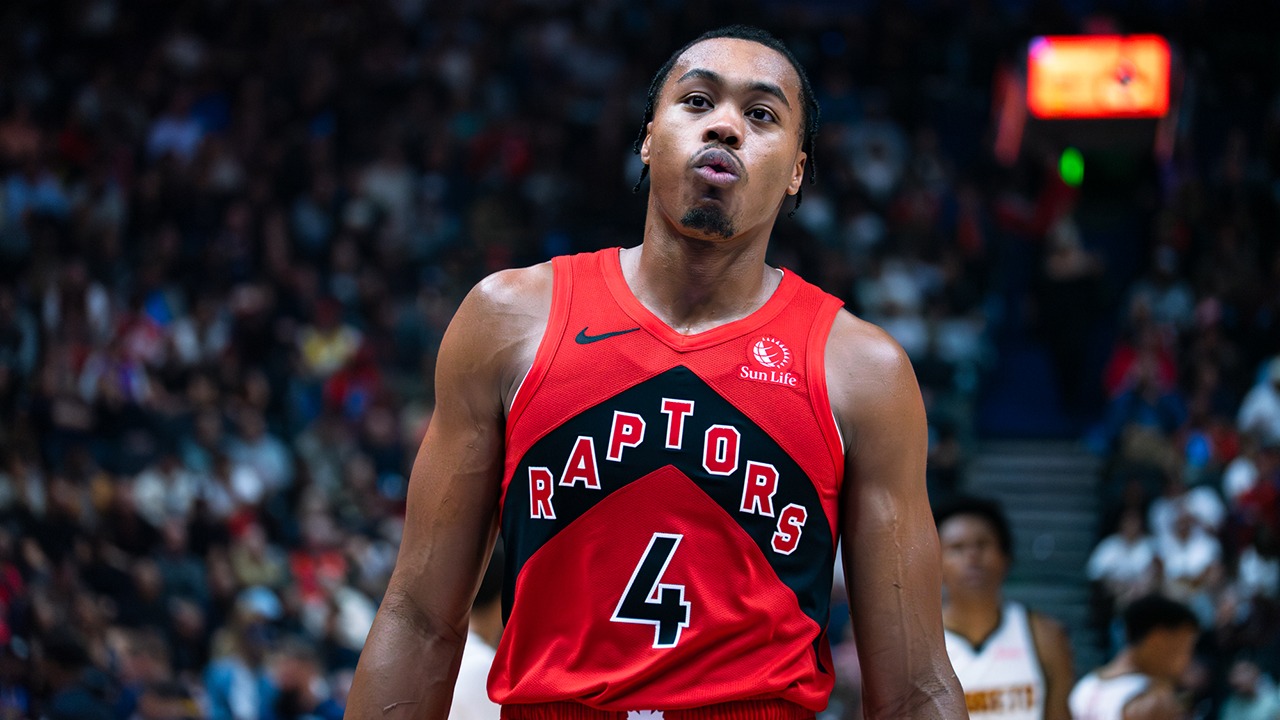
It started with a thunderous dunk. Scottie Barnes caught the ball near the baseline, ripped through en route to the rim, and punched the ball with one hand over the helpless helper. It was clear that he was not going to waste this shot.
With Immanuel Quickley sidelined with plantar fasciitis and Jamal Shead struggling recently, the Toronto Raptors decided to start Barnes at center in their revenge match against the New Orleans Pelicans. It was Barnes’ first game starting as a point guard this season. In fact, his role has in many ways gone the opposite direction this season, with him playing a third of his time as the team’s center.
And given this chance, Barnes responded.
Barnes passed with aplomb. He found cutters and shooters. He collected hockey assists, too, when the defence overreacted to his first-option passing targets. Early on, he sent an entry pass into the paint from half-court, leading to a layup. He hit pull-up jumpers from all across the court as instead of bumping and grinding his way through drives, he looked for one- or two-dribble jumpers from the free-throw line extended. He finished with 23 points, 12 assists, seven rebounds, three blocks, and two steals.
In many ways, it was Barnes’ high point on the offensive end this season. He’s had better games, better impact, gaudier numbers. But in different ways. This season, the Raptors have mostly moved past the concept of Barnes as an initiating star that they have tried to facilitate in past campaigns. After struggling with creation last season, the Raptors asked him to be more of a finisher and less of a creator this time around. Brandon Ingram supplanted his role there, which was surely part of the motivation behind his acquisition.
And Barnes has been terrific as a finisher! He’s shooting 69 percent at the rim and 45 percent from the mid-range, both elite marks. And his finishing is quite differentiated by whether it’s coming off the bounce or the catch. When shooting out of a cut (67 percent) or as a pick-and-roll roller (67 percent), he’s fantastic. But when shooting as a pick-and-roll handler (47.5 percent), out of the post (49 percent), or out of isolation (54 percent), it’s far worse. When others create for him, he’s one of the league’s best. When he creates for himself, he’s solid, but no better than that.
There are limitations to how impactful a player can be on the offensive end as a non-shooter and middling creator. Think Evan Mobley, Anthony Davis, bigs of that nature: they are very strong offensive players who need better ones alongside them if they’re going to be on good offensive teams. Despite at times moonlighting as a guard, and being given plenty of chances to be more, Barnes has ended up in that category.
But his work against the Pelicans was in many ways Barnes’ first moment of primary stardom this season. He had seven first-half assists, many of them coming as over-the-top, transition home runs that led to layups. He slung dimes from the hip like a cowboy. He hit no triples — and in fact didn’t attempt any. He found himself at the rim infrequently, and he attempted only three free throws. But he still managed to run a strong offence as the starting point guard. And he didn’t lose his work as a play finisher just because he was starting plays. Late in the first quarter, he swiveled his post-up as the ball switched the side of the floor, finding a contested dunk as Shead’s entry pass found him under the rim. In the third he ran the big position with Shead and rolled for a dunk.
Barnes’ inability to do this for much of the season has, also, defined the Raptors’ season. His weaknesses are, in no particular order: shooting, driving through nail help, self-creation. Those, too, are the Raptors’ greatest weaknesses. Barnes is one of the best pure passers in the NBA. But his scoring limitations mean that the situations in which he creates passing windows are themselves fewer than they should be.
The Raptors desperately need a player who can hit pull-up jumpers, who can hit the paint at will, who can force defences to respond to his every movement. Barnes is not that player. But he can carry some of the burden, or at least more of it.
Against the Pelicans, Toronto’s starting lineup with Barnes at point guard finished with an offensive rating of 145.5. It was one game, and they faced a poor team. But it was meaningful because Barnes was able to accomplish so much in a situation in which he has erstwhile struggled. As a point of comparison, the Raptors had an offensive rating of 111.6 last season in 369 total minutes when Barnes played without any other point guard.
Barnes simply hasn’t been a strong point guard to this point in his career. Until his one game against the Pelicans. One game does not turn around a long trend, but it isn’t nothing, either.
On the other hand, Barnes’ greatest strengths have been defence of all kinds. He is basically elite in every area of that side of the floor, but his best areas are rim protection, shrinking the floor as a helper, forcing turnovers, and eating clock. Those, coincidentally, are the team’s best qualities as a defence. Barnes’ weakest area of defence (at which he is still very strong) is actual on-ball work — which is Toronto’s weakest component of defence, too.
“Gimme that shit!” he yelled in the third quarter, moments before he erased a Pelicans’ layup attempt in transition.
Toronto is ranked eighth in defence on the season, largely driven by Barnes’ superpowers on that end. His defensive on-offs lead the team, and he has performed in virtually every role, guarding every archetype of offensive player. He has become a defensive superstar, full stop.
It was clear that he would offer this level of intentionality and effort this season. Last year, even with the Raptors tanking, Barnes never being a tryhard on the defensive end. He had every reason not to do so, including with his coach seeming to undermine the team’s winning chances at times, but Barnes simply couldn’t be anything less than a monster on defence. That type of impact translates, and indeed it has this season.
The Raptors are simply defined by Barnes, for good and for ill. He is their floor and their ceiling, their heartbeat and their brain, their emotional engine and their leader.
And Barnes is a very strong player, so the Raptors therefore are a very good team. They are currently 41-32, well above pre-season expectations of the team, and on track to make the playoffs outright rather than through the play-in.
But the team’s limitations are equally in place as a result of Barnes. He is very good, but it’s clear at this point that he is not a transcendent superstar, not in the class of players who can define their teams all the way to championship contention. Barnes and the Raptors have co-defined and at the same time ossified themselves this season. It is in both of their interests — and represents both of their obstacles — to redefine themselves going forward.