This is a guest post from occasional contributor Atique Virani.
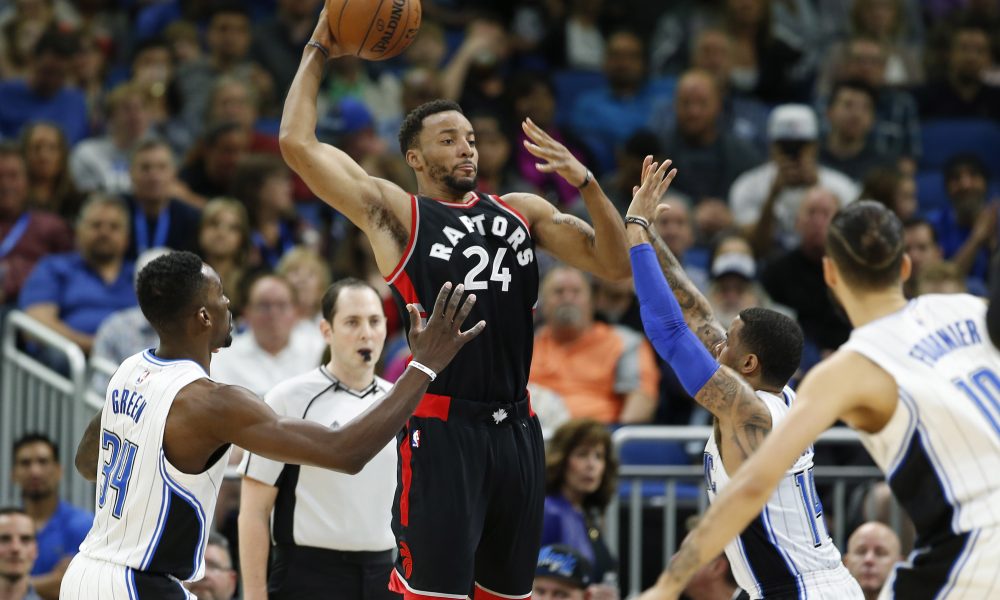
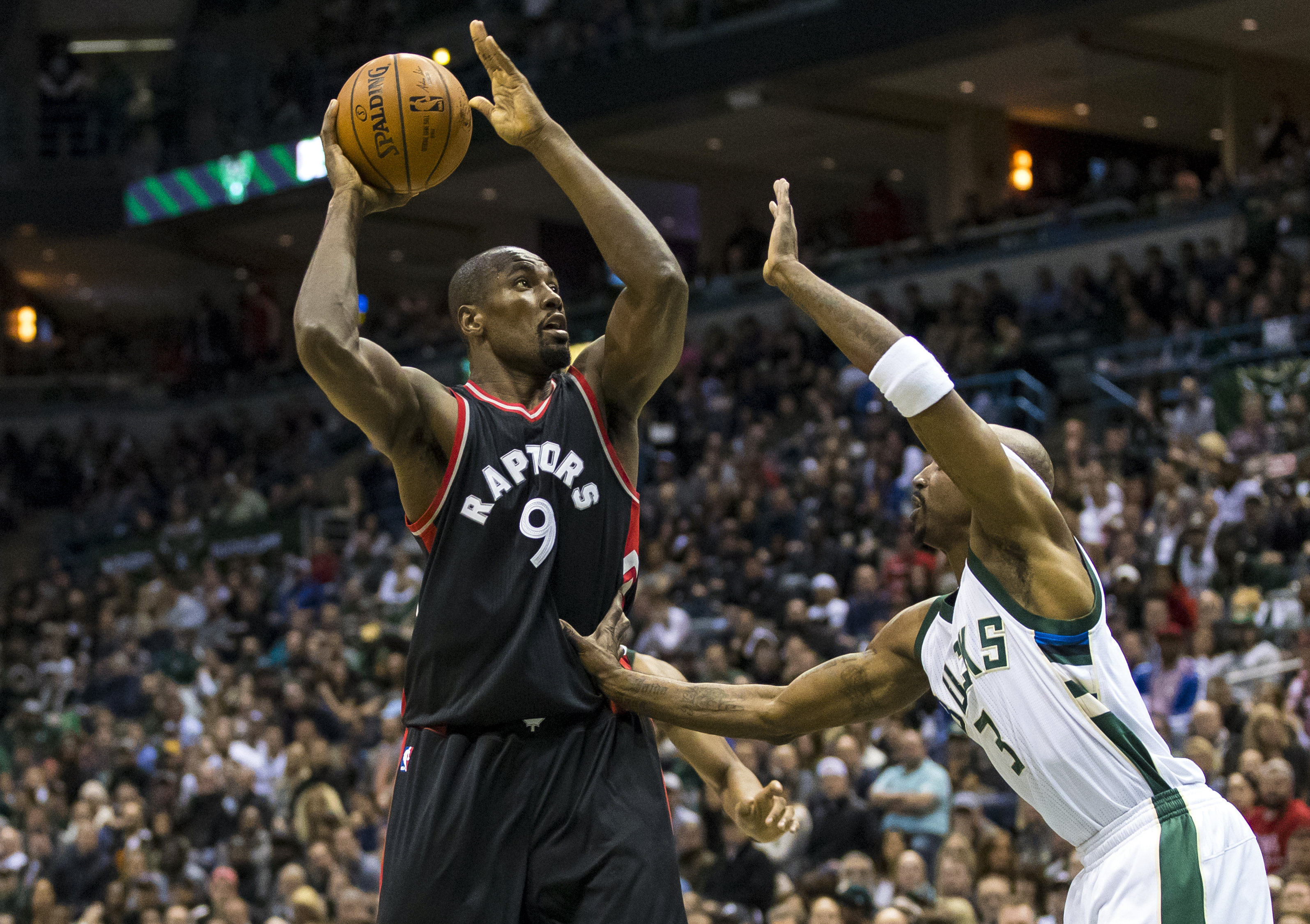
On February 14th, 2017, Masai Ujiri finalized what was probably his biggest trade as President of the Toronto Raptors. He sent Terrence Ross and the lesser of Toronto’s two 2017 1st round draft picks to the Orlando Magic in exchange for Serge Ibaka, the extraordinarily handsome man who for the previous three seasons had been the third banana behind Kevin Durant and Russell Westbrook. Masai made this trade in order to give Toronto’s core a fair shot at proving itself against the Cleveland Cavaliers, without being forced to play Pascal Siakam or Jared Sullinger alongside Jonas Valanciunas.
As you know by now, that experiment didn’t turn out so well. The Cavs blew past the Raptors with only the barest modicum of effort, winning comfortably in every game. That wasn’t entirely unexpected – after all, LeBron James, one of the two greatest players in NBA history, plays for Cleveland, and the Raptors have no one even close to his level. And so the debate has shifted from whether Ibaka would help the Raptors dethrone the Cavaliers, to whether the Raptors should re-sign Kyle Lowry and Ibaka and run this team back one more time, perhaps with a few changes around the margins.
The question of whether to re-sign Kyle Lowry deserves its own column, because it’s a complex question with no easy answer. But as you can probably guess from the title of this post, I want to talk about whether or not the Raptors should re-sign Serge Ibaka, specifically why they shouldn’t. The consensus among Raptor fans (despite a dissenting opinion from Zach Lowe in his excellent postmortem of Toronto’s season) has been that since, on the surface, he’s a pretty perfect fit for Toronto, re-signing Ibaka is the easy choice to make. But the decision isn’t as clear-cut as it appears.
The most noteworthy strike against Ibaka is his (apparent) decline. Although I don’t want to cast doubt as to the veracity of his listed age, his statistical profile clearly emulates that of a player on the downward slope of his career. According to Basketball Reference, many of Ibaka’s advanced statistics have been declining for a few seasons now. His Block% has declined every season since 2011-12, and is currently the lowest it’s ever been in his career, along with his Offensive Rebound%, and his Defensive Rebound% is the second lowest it’s been in his career. These numbers aren’t completely explainable by a move to the perimeter, either, since with the Raptors he played the highest percentage of his minutes at C, without any improvement in those numbers. In addition, his all-in-one stats have suffered as well. His Box Score Plus-Minus, Value over Replacement Player, and Win Shares per-48 minutes stats have steadily declined since the 2012-13 season, and are currently the lowest since his rookie season.
Of course, a team like the Raptors wouldn’t re-sign Ibaka for the regular season benefit – they’d be looking to his playoff impact – which is why it’s concerning that these trends hold true for most of his playoff numbers as well – his PER, BPM, WS/48, and VORP in these playoffs rank among the worst years of his career. Add to that the fact that through the eye test, it’s becoming increasingly obvious that Ibaka isn’t really quick enough or athletic enough to play Power Forward full-time anymore, and on offense his main value is as a shooter on the perimeter, not as a screener or as a roll threat in the paint, drawing help away from shooters. This isn’t to say that Ibaka’s been bad – on the contrary, he was an integral part of Toronto’s series win over Milwaukee, and although he struggled at times against Cleveland, so did everyone on the team. But the point here is that it’s probably not a good bet that Ibaka will show significant improvement in the future. At best, he’ll probably maintain a similar level of production.
The general counter to these numbers and observations from Raptors analysts and writers has been that it’s time to move Ibaka to Center and trade Jonas Valanciunas, for value if you can get it, or salary cap relief if you can’t. And this is accepted wisdom because Ibaka is obviously a better defender than Valanciunas, and so would help the team more. Fortunately for us, we’ve actually seen a decent amount of high-leverage minutes this postseason in which Ibaka and Valanciunas have been separated, thanks to Casey playing JV off the bench for nearly half the playoffs, and the results in those minutes have been surprising, to say the least. To start with, according to the great site nbawowy.com, the Raptors have been thoroughly outscored almost regardless of who’s on the court, as should be expected after the blowouts Cleveland has laid on Toronto. But with Ibaka on the court without Valanciunas, the Raptors are actually outscored worse than when Valanciunas is on the court without Ibaka. It’s actually not that surprising that the defense is approximately as effective with Valanciunas on the court as opposed to Ibaka – Cleveland has proved impossible to stop for nearly any lineup combination, regardless of who’s playing center. The numbers do bear out a few interesting observations, however. The first is the troubling tendency for Ibaka’s offense to stall when he’s playing C. His True Shooting% dips to .505, and it’s worth wondering if the strain of defending the rim full-time has an effect on his jumper, since he relies so much on outside shooting for his offense. The second is that when Valanciunas plays next to a true PF – that is, not Ibaka, who’s closer to a C now, or Siakam, who’s not worthy of playoff minutes yet – he’s shown the ability to play decently, relative to the norm for Toronto, on defense, alongside his typically efficient scoring.
The picture painted by these statistics and the actual games themselves isn’t a pretty one. If the Raptors hope to keep Ibaka, they’ll probably have to pay him somewhere in the neighbourhood of $25 million a year, probably for 4 or 5 years. Considering Ibaka’s statistical profile, it’s almost certain that he’ll be in heavy decline by the last few years of that contract, and there’s a chance that drop-off will happen even earlier. And because Ibaka will have to move up a position to combat his declining athleticism, that will mean that Valanciunas will probably have to be moved as well, and the Raptors will have another hole at PF.
Now, as an avowed Valanciunas fanboy, I’ve been in favor of trading him for a while now. It’s pretty clear that he’s not a good fit with Casey’s offense, and playing him with DeMar is a disaster waiting to happen on defense. But if the Raptors are faced with the choice of moving a still-young center on a relatively cheap contract in order to re-sign a clearly aging big man who, by most statistical measures, is being out-produced by the younger player, to a gargantuan contract, I believe the smarter choice would be to hang on to the younger player. Still, considering that Ibaka’s trade value is higher than Valanciunas’ right now, Masai may decide that the smartest course of action is to re-sign Ibaka now, only to trade him if a favorable deal becomes available, similar to how he handled the Nene re-signing as the GM of the Denver Nuggets. Regardless of what Masai chooses, it’s up to us as fans to not to fall into the sunk cost fallacy, and clamor for Masai to keep Ibaka solely for the reason of not losing the perceived value of the 1st round pick and player that were traded to obtain him.