
Quick Reaction | Reaction Podcast | 3-Minute Analysis
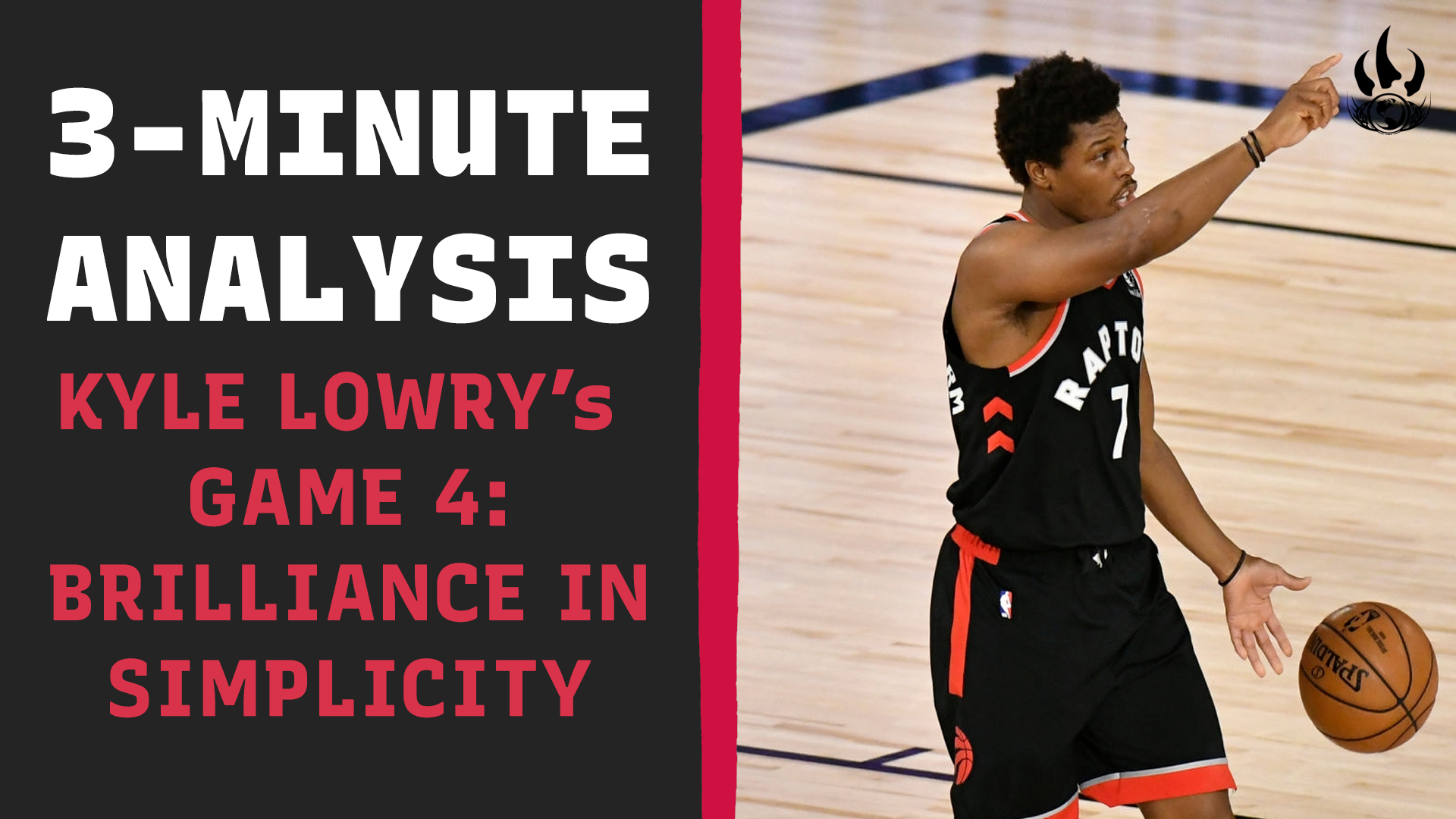
With three minutes left in the game, the Toronto Raptors led the Boston Celtics by nine points, close to the team’s largest lead of the series. The Raptors were tired, but holding up. Kyle Lowry had played 41 and a half of the game’s 45 minutes to that point, after playing all but one and a half of game three. He took two charges in game four, one of which from Jaylen Brown would have shattered the bones of a mere mortal, and Lowry had suffered innumerable other smaller collisions under the rim as he collected his 10 rebounds.
His exhaustion meant nothing to him.
Lowry guarded Jayson Tatum at the top of the key, as he had for much of the game. The Celtics thought they had an easy pass to Tatum, and it came, but Lowry dug into Tatum’s legs and tipped the ball away. Tatum shuffled to regather it, but Lowry dashed after him with the frenzy of the Running of the Bulls of Palmplona. Tatum bent to pick up the ball, but Lowry dove, fully outstretched like a long jumper. He smashed into Tatum, hitting the ball first of course, and the two of them tangled and slid together out of bounds. The ball was deemed a jump ball, as not even the referees, with all the power of technology, could determine which player had touched the ball last.
“That’s what it’s about, man,” said Fred VanVleet of the play. “Playoff basketball. I know Kyle kinda embodies what this team is.”
Lowry finished with 44 minutes played in the game. For Nurse, it wasn’t really an option not to play Lowry so many minutes.
“I did check with him, a couple of times,” said Nurse after the game. “I was joking, I asked him if he needed a sub with a smile, he’d chew me out, ‘I don’t need one.’ I was kind of kidding… I think our guys are used to playing, not this many minutes, but they’re used to playing heavy minutes and they’re used to playing in this intensity and playoff games.”
“They’re okay.”
Lowry wasn’t the only ones playing big minutes. Pascal Siakam and Fred VanVleet both finished with 45 minutes played, in fact more than Lowry. VanVleet, like Lowry, had also played over 40 minutes in the previous game, too.
“I mean, if you’re ever going to do it now’s the time to do it. There’s nothing to be resting for, there’s no tomorrow,” said VanVleet. “There’s not really another option at this point.”
Lowry and company ground the Celtics to dust in a 48-minute boxing match. Toronto won 100-93, never trailing other than for a short stretch at the end of the first half and start of the second.The game was a physical fight inasmuch as any modern basketball game can be, full of batted arms, tackled torsos, and, at times, full wrestling moves. Those ugly games can favour Toronto.
“We’re…okay being uncomfortable and not being pretty,” said VanVleet. “I think we can win in many different ways and I think that we’re very versatile and just trying to keep continuing to find ways to win. It’s not always going to be pretty but I think we’re comfortable with how ugly and mucky the game is now.”
The Celtics have aesthetically pleasing scorers. Kemba Walker’s pull-up jumper is one of the league’s prettiest and deadliest offensive weapons, yet the Raptors held him to nine attempted shots and only 15 points in game four. Jayson Tatum is one of the league’s most polished scorers, far smoother than any Raptor on the offensive end, yet he scored only 24. That’s not enough to be better than Lowry, and that’s not enough to beat the Raptors.
For Toronto, the leaders were Lowry and Pascal Siakam. Neither was close to shooting 50 percent from the field, unlike their counterparts on the Celtics in Walker and Tatum, but both Lowry and Siakam played more complete games. Lowry, as he always does, played like a lunatic on both ends of the floor. Defensively, he spent time defending the perimeter, switching into the post, tagging centers, and blocking out piles of Celtics on the offensive glass. Frequently he did all that on the same possession. He was most frequently Toronto’s primary defender on Tatum, where he was, as he has been all series, wonderful. Offensively, Lowry was Toronto’s most consistent source of good shots, and when he ran the pick-and-roll, Toronto always found good looks.
When VanVleet caught fire in the third quarter and hit a pair of relocation triples, it was Lowry who was passing him the rock. When Serge Ibaka scored out of the pick-and-roll, it was frequently Lowry hitting him with bounce passes in the pocket. Ibaka, by the way, finished with 18 points on only nine shots, and his ability to drain every jumper he throws at the rim is Toronto’s life-blood for long stretches. Without Ibaka’s consistency on the offensive end, Toronto would not have tied this series at two games apiece. (Speaking about consistent greatness, superstar Vivek Jacob’s player breakdown is coming at 1:00 pm ET, and it will be about Ibaka’s game, so there will be more depth coming there, and you should be excited.)
Ibaka finished plays. VanVleet finished plays. But it was Lowry initiating them. To get into the nitty-gritty behind Lowry’s play-making, check out Zarar’s awesome three-minute film breakdown here. With Lowry at the wheel, Toronto finally shot well from deep, hitting 17-of-44, or 38.6 percent. And Toronto practically led wire to wire as a result. Lowry finished game four with 22 points, 11 rebounds, 7 assists, 2 steals, and 2 blocks. All were team-highs except for the points, which were one away from the team-high.
It was Siakam who scored the most points for Toronto in game four, with 23. It took him 23 shots. This may be burying an important fact, but Siakam shot 2-of-13 from deep. His offensive confidence seemed wayward for much of the first half, as he settled for triples, and eventually started bricking open ones. He wasn’t deterred for long.
“It’s just a fine line between makes and misses,” said Siakam. “I can’t change who I am. I’m going to continue to play the way I’ve been playing.”
That being said, he did change how he played in the second half, albeit slightly. Nick Nurse shifted him away from the imitator role, leaving that mostly to Lowry and VanVleet, and let Siakam finish plays more frequently. He spent more time in the corners, cutting around off-ball screens, and lurking in the dunker spot. It worked well. Siakam actually finished shooting 8-of-10 from inside the arc, and when Toronto shifted him back into the post to help close out the game, he responded with some timely clutch face-up jumpers.
Siakam’s game is difficult to judge at the moment. On the surface, there are problems. Two-of-13 from deep, a team-high in three-point attempts, is perhaps problematic. But he still scored semi-efficiently, particularly given the offensive difficulties for everyone playing in this defensive series, and Siakam played his patented brand of stellar defense. He is great defending in isolation, helping at the rim, or closing on a shooter. His ability to start 12 feet away from a shooter and still impact the shot is a unique superpower, like Steph Curry’s jump-shot or Kyle Lowry’s charge-taking. The shooting sticks out like a sore thumb, at surface level, but Siakam’s game was multi-faceted and, on the whole, positive. He fits into the grit and grind of the series, and of the Raptors on the whole, with ease.
After Toronto’s mucky game four win, the series is now even. The designated home team has yet to win a game, which means nothing, but also fits with the general griminess into which this series has sunk. That’s where Toronto thrives. As long as each game is played slow and ugly, Toronto has the advantage. It’s on Boston to respond. But as long as Toronto has Lowry leading the way, the Raptors will have an answer. He’s playing on a bum ankle, and he’s notched 89 minutes in the last two games, and he’ll probably play more than 40 in every game going forward, but he remains the most valuable player on either team. Exhaustion doesn’t affect him. Injury doesn’t seem to affect him. And it’s now on Boston to figure out what will affect Lowry because if all else remains the same, the Raptors will win this series.