
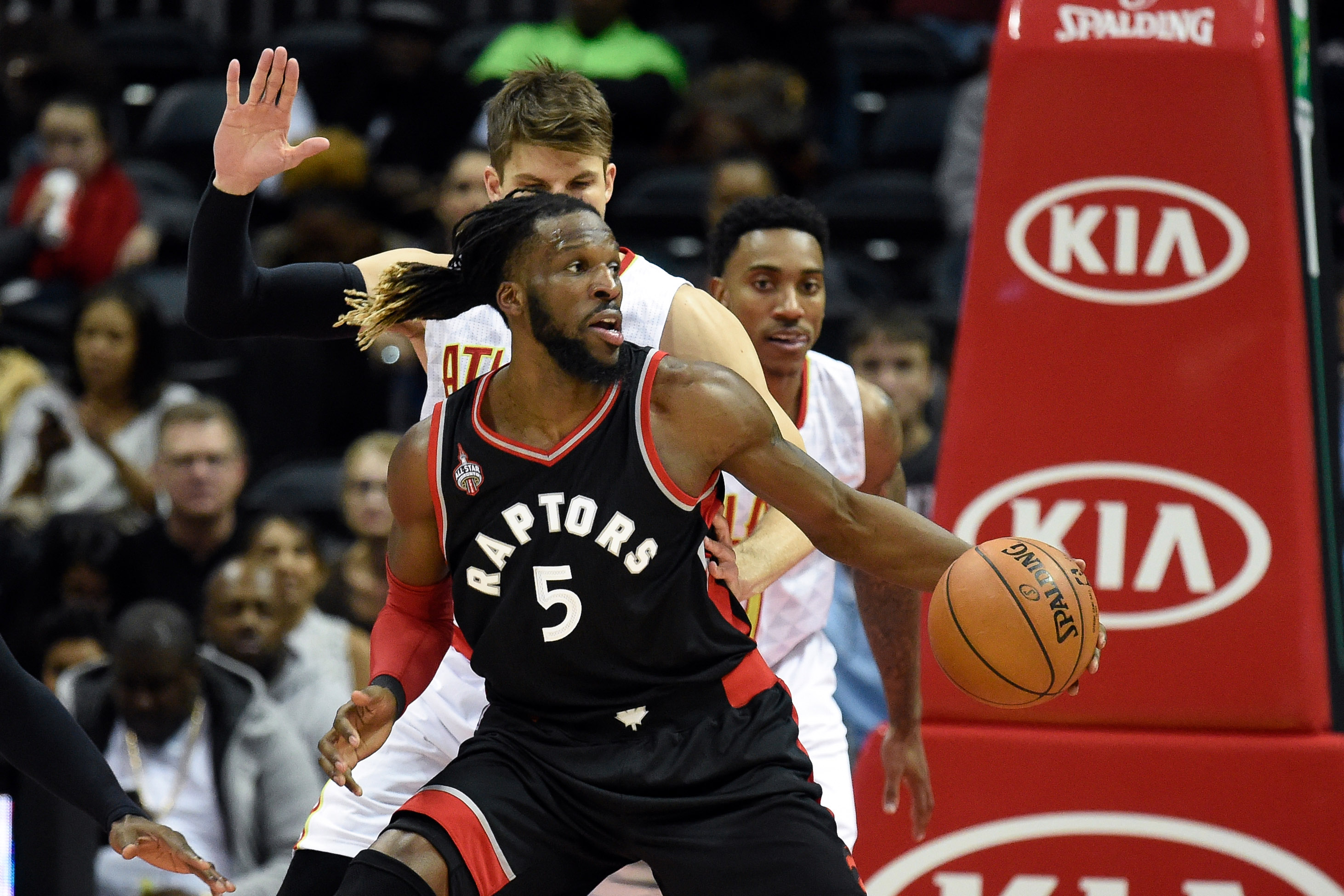
DeMarre Carroll underwent arthroscopic surgery on his right knee Wednesday morning, the team announced.
There is no timeline for his return, nor is there any indication as to the specific type of surgery or the injury at play, so it’s really difficult to figure how long he may be out for. Arthroscopic surgery can mean different levels of invasiveness and different recovery timetables, though Lowry was adamant to Ryan Wolstat of the Toronto Sun that Carroll is not done for the year. So that’s good. Head coach Dwane Casey said that the injury is more long-term than “week-to-week,” though, per Alex Wong. So that’s bad. Michael Grange and Bruce Arthur are both reporting that it sounds like a six-to-eight week absence.
Per the team’s release, Carroll had the surgery in New York, where the team is set to take on the Brooklyn Nets on Wednesday. Logic would dictate that Carroll will head back to Toronto from here rather than continue traveling with the team on their road trip, which doesn’t see them play a home game again until Jan. 18.
Carroll missed three games early in the season with plantar fasciitis, then banged knees with DeAndre Jordan chasing J.J. Redick around a screen shortly after returning. He played through soreness for over two weeks before being diagnosed with a right knee contusion, then missed nine games to heal up. He returned on a minutes restriction for five games before sitting Monday with increased swelling in the knee, talking cryptically both Sunday and Monday.
Here’s Carroll from my recap Sunday:
Carroll was open if not forthright about still being less than 100 percent after the game.
“He got in a nice groove. He had it going. I’m going to be quiet with what I really want to say. I take it on myself but I know I’m not all the way there,” Carroll said. “I don’t want to speak too much but I’m not all the way there. And he did what he’s supposed to do against a guy who’s not all the way there.”
Taking the blame when he played just 10:46 of the final 24 minutes is perhaps asking too much of himself. (His health is a discussion for another post.) Ross gave a good effort and navigated screens well, and DeRozan spotted in when called on, but neither is a great matchup for Butler, who has few great matchups. Carroll is supposed to be that guy, and at less than 100 percent, he wasn’t able to be.
And here’s Carroll courtesy of Chris O’Leary of the Toronto Star on Monday:
It’s one of those things where I could play, but me playing at 65 per cent is not…I don’t think everybody looks at it as beneficial. (That) kind of makes me sound selfish, but I’m not. It’s just that Alex (McKechnie), he wanted to hold me out. He said he felt like I’m putting myself at risk more out there playing and the way I play. We’re going to go through a couple of procedures and see. I’ll see what the next step is.
…
I’m frustrated right now…What can I do? I don’t want to say too much, because you know how the Raptors do, we keep our stuff hush. I don’t want to say too much, but at the same time man, only if you knew, you know what I mean? Only if you knew. It’s one of those things.
The comments from Carroll, along with comments from head coach Dwane Casey about this being an opportunity for T.J. Ross, James Johnson, Norman Powell, and Anthony Bennett, suggested something larger was at play here. However long Carroll misses, everyone needs to practice patience; he’ll be measured almost entirely by how he changes this team’s outlook in the playoffs, and there’s little sense valuing the regular season over that end. The Raptors can get to the playoffs without him, and they need to take whatever lumps come their way in waiting for him to get back to 100 percent, a place he’s rarely been this season.
This is a tough situation to evaluate, really. I understand that many will rush to say the Raptors mishandled his injuries and his returns, or that they were playing him too many minutes (not the case since his latest return), but as outsiders, we really don’t have the kind of information necessary to judge the process. For what it’s worth Carroll said the plantar fasciitis that cost him three games earlier in the season isn’t much of a bother anymore. And he played through the contusion originally because he was trying to play through what he thought was just general swelling (context suggests he may not have told the team he was in pain). The team obviously decided he was ready to return with restrictions, and they’d know better than we would. It’s possible something is going on in the knee that made it look fine on the surface but susceptible to aggravation, and the team didn’t want to put Carroll under the knife unless necessary. We really don’t know, and it’s assuming too much to think the generally well-regarded Raptors medical staff erred egregiously here.
In 23 games, Carroll was averaging 11.7 points, 4.8 rebounds, and 1.7 steals while shooting 38.8 percent from the floor and 37.8 percent on threes. Were it not for that outside shooting mark, his offense would grade out poorly, as his effectiveness as a cutter had waned dramatically. Despite Jimmy Butler’s outburst Sunday, Carroll had still been able to provide a defensive presence, but he’s labored to do so. The Raptors are 5.5 points per-100 possessions better without him on the floor this year due to a mix of ineffectiveness, injury, and assignment, and they need him at 100 percent to reach their ultimate ceiling. Patience, everyone. Please.
This is a big opportunity for Johnson and Ross, to be sure.
Johnson’s role has been on a yo-yo this season due to his place as the rotation’s 10th man, a matchup specialist, and an emergency starter. He’s played mostly well when called upon, averaging 4.9 points, two rebounds, and one assist in 14 minutes, and he’s the closest thing the Raptors have to Carroll in terms of strong, versatile wing defense. In seven starts, Johnson has been even better, averaging 8.6 points, 3.4 rebounds, two assists, 1.1 blocks, and 1.1 steals in 26.8 minutes while shooting 53.3 percent from the floor. On the season, the Raptors have been 0.1 points per-100 possessions worse with him on the floor, essentially a null change that speaks to the value he’s provided in preventing slippage due to injuries.
Still, for all the good Johnson does – creative passing, secondary ball-handling, man-to-man defense – he has a few areas of weakness that have made Casey reticent to play him unless absolutely necessary. Johnson gets sleepy defending off the ball, makes curious help-decisions at times, and can get overzealous with the ball in transition. His lack of a 3-point shot – he’s 6-of-20 on the year and at 26 percent for his career – makes him a tough play on the wing alongside DeMar DeRozan, a spacing concern that gets exacerbated if Luis Scola or Bismack Biyombo are on the floor, as well. That’s something the team can scheme around (tethering Patrick Patterson to Johnson) or simply live with, and the Johnson-DeRozan pairing has narrowly outscored opponents on the season.
For Ross, this is a test, and an important one. As of next season, the Raptors are paying him like a quality third wing and reliable spot-starter, something he absolutely did not look like early in the year but has since Dec. 7. That was the first day Carroll missed with his second injury, and Ross has played much better at both ends since. In 15 games, seven of them starts, Ross has averaged 10.9 points and 2.9 rebounds while hitting 40.2 percent of his threes and engaging much more noticeably on defense. Ross is hardly a lockdown defender but he’s athletic and disruptive, adept at jumping passing lanes to start the transition offense the other way, and he’s gotten lost in pick-and-roll coverage less often of late. That’s damning with feint praise, but the team only needs him to be passable at that end if the shots are dropping.
In terms of who starts going forward, I’d personally play the matchups, but Casey seems unlikely to do that. The prudent move would be to start Johnson opposite any capable wing scorer, particularly bigger ones, giving DeRozan a reprieve at that end, while starting Ross against lesser offensive players to goose the team’s own offense. Were I to guess who gets the starts regularly moving forward, I’d guess Ross, if only because he started most recently when Carroll was out.
Johnson is going to draw the start Wednesday, but the situation will be fluid, Casey confirmed, per Alex Wong.
This could also open up minutes for Powell and Bennett. Powell has been solid on his D-League assignments and could bring defense and energy to the second unit, though he brings spacing concerns of his own and his struggled to finish at the rim in small NBA minutes. I’d definitely suggest he’s worth a look, at least filling in Johnson’s old role as 10th man. We’ve seen little of Bennett, so it’s tough to tell what he could bring, but the team seems to believe he can be a passable defender and rebounder as a combo-forward. It’s tough to evaluate him on a bunch of short stints, so it will be interesting to see if he gets additional run now.
This probably isn’t a call for a panic trade, either, even if Carroll’s absence extends toward the trade deadline. The Raptors have excess picks but few assets on the roster, and finding workable deals is pretty difficult. Panic trades are rarely the right answer.
For the Raptors as a whole, the timing couldn’t be better, if Carroll had to go down. The Raptors have the Nets, Wizards, and Sixers this week, then one game in eight days, then a relatively friendly seven-game home-stand. And they’ll want Carroll to find a groove entering the playoffs, so it’s much better that this happens now than later, if it was going to happen at all.
Wring your hands or let out your frustrations, by all means. But this isn’t the end of the world and the Raptors should be fine. This team was never going to be measured by regular-season performance, and the latest setback for Carroll serves as a reminder of that. Just get him healthy for April.

