For a game that very nearly slipped away and saw the Toronto Raptors in an 0-2 hole, Tuesday’s defeat of the Milwaukee Bucks had a lot of little things to be encouraged by. Kyle Lowry played much better. Ball movement was a more obvious emphasis, save for a six-minute stretch of the third quarter. DeMarre Carroll and Cory Joseph saw their minutes trimmed some, Patrick Patterson’s went up, and the P.J. Tucker-Patterson-Serge Ibaka frontline – as well as the closing lineup that included those three – saw ample run a game after inexplicably seeing next to none (yes, Dwane Casey makes adjustments). Ibaka looked great once he got going, too.
It was not a perfect game by any means, but as far as reasons for optimism in a tight six-point win, there are reasons to think the Raptors are getting it together to some degree. Perhaps the most encouraging of the signs from an individual perspective was the play of two of the team’s young players.
Jakob Poeltl saw some first-half run, and while he was solid in four minutes – the Raptors didn’t miss a shot during that time, he finished on a nice cut to the rim, he hedged well in the pick-and-roll – he was playing because of a combination of foul trouble for Jonas Valanciunas and a desire to avoid over-taxing Ibaka’s ankle early on. Poeltl has proven steady when called upon, playing within himself and his role, and it was nice to see him respond to playoff intensity without missing a beat. Had Lucas Nogueira not lost his backup center job thanks to an ill-timed stretch of shaky play around the All-Star break, the Brazilian is, tactically speaking, a preferable option against an opponent like the Bucks (even if Greg Monroe did have his way with him a bit earlier in the year), but Poeltl providing a semblance of safety and floor is important, too.
Poeltl probably won’t be called on a ton game-to-game, especially since the Raptors looked so good with a Patterson-Ibaka frontcourt again. That doesn’t make it any less encouraging that he affirmed Casey’s belief that he’s there if needed.
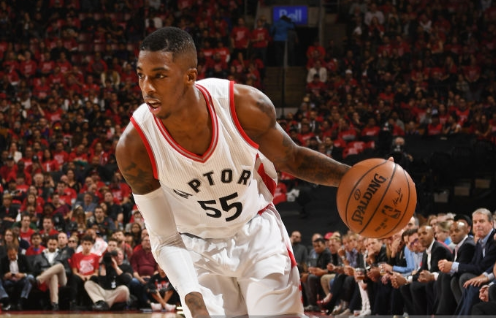
Delon Wright, though, may have made a case for Casey to fundamentally change his rotation the rest of the series.
This is actually a case Wright’s been making for some time, to be clear. Initially expected to factor in a year ago, Wright was pushed to a third-string role but showed nice development in the D-League. He was showing more of the same in Summer League, when a dislocated shoulder and torn labrum not only ended his offseason but threatened his role for this year. Fred VanVleet ran with the third point guard slot even as Wright looked back to form with Raptors 905, and it wasn’t until an unlikely pre-deadline comeback against the Charlotte Hornets and the subsequent injury to Kyle Lowry that put Wright in a position to show his growth in a meaningful way at the NBA level. His play with Lowry out, while unsteady initially, was perhaps the single biggest silver lining of the All-Star’s absence.
(Raptors Republic readers, by the way, have been clamoring for more Wright throughout all of this.)
"I liked Wright in Summer League" / "I liked him when he was still with 905" is my new "I liked Fall Out Boy before they were popular"
— Blake Murphy (@BlakeMurphyODC) April 19, 2017
With the Raptors’ nine-point lead in the second quarter chipped down to two, Casey called on Wright in place of Cory Joseph. Normally, this is a chunk of time in the rotation where Lowry and Joseph share the floor, and it’s been very effective over the last two seasons. Milwaukee’s length poses problems against that two-point guard lineup, though, and they’ve done well seeking out switches that force a smaller guard onto Giannis Antetokounmpo or Krhis Middleton. Wright is not exactly Tucker in terms of stature, but he’s big for a point guard, with the length of a wing and a savvy, sneaky defensive focus that helps his size play up, especially when it’s one of the games in which he’s fighting through screens better (Wright believes this is his biggest area of weakness, by the way).
With a Lowry-Wright or, later, a Joseph-Wright pairing, the Raptors minimize the risk of being small without sacrificing too much in terms of ball-handling. Wright is a better penetrator than Joseph, and while he’s not the same shooting threat, the ability to attack the weak side is paramount against Milwaukee’s traps, and Wright’s slithering, amoebic drives help keep the Bucks from resetting as they scramble to re-balance their defense on a swing.
On Tuesday, Wright’s performance maybe didn’t jump off the page. Box score surfers surely didn’t catch it, as Wright went scoreless with two rebounds and three assists in his 8:25 of action. Even the Raptors’ plus-1 mark during that span betrays his impact some, as he was responsible for helping create a few Raptors scores and frustrate the Bucks at the other end, two things the Raptors hadn’t gotten from their two-point guard lineups so far in the series (save for maybe the early second quarter of Game 1).
https://twitter.com/DWRIGHTWAY1/status/854486002265604101
Offensively, the biggest thing Wright was able to do was attack from the corner, either in an attempt to finish through length at the rim or to goad the defense into collapsing for a kick-out.
He was also able to take the much larger Middleton off the dribble when a play seemed to die out in the strong corner, no easy task even when Spencer Hawes is the helper.
I don’t have anything to say here, this is just a really zippy pass.
One of Wright’s rebounds came on the offensive glass, something that’s become a major strength for him (he ranked 11th in offenswive rebound rate among all players 6-foot-6 and under who played at least 400 minutes this year). Casey doesn’t like sending anyone toward the offensive glass other than Valanciunas, and the Raptors have posted anemic offensive rebounding numbers in the series so far. Wright’s anticipation is terrific, though, and he’s often able to hunt down longer rebounds that have him moving back on defense even if he can’t come up with them.
That same aggression in the open court also helped force an Antetokounmpo travel.
In the half court on defense, Wright’s impact wasn’t as clip-worthy beyond just doing a solid job opposite Malcolm Brogdon. He wasn’t perfect, getting beat once and forcing Valanciunas help that left the glass open for an Antetokounmpo rebound, but he was mostly good, recovering well if he was caught on a screen and anticipating them otherwise.
He also had a nice dig-down on a Greg Monroe post-up that helped force an out of bounds and eat clock. Twice on the same play, Wright reads the distance and angle he can help off of Brogdon, and Monroe has no clue the second swipe is coming.
Wright’s length came in to play after he lost the handle on a key defensive rebound, too, as he was left in a position to contest an Antetokounmpo pull-up.
Again, none of this is to say Wright was perfect, or would be if his role was expanded beyond the roughly nine minutes he played here. The more the Bucks see him, the more they may look to attack him and test his ability to withstand post-ups from bigger players. Casey probably isn’t going to have Wright jump Joseph in the rotation – Wright didn’t play at all in the second half – because he trusts Joseph, Joseph is a more established shooter as of this year (and the Raptors are a little starved for that necessity against Milwaukee’s defense already), and the Lowry-Joseph pairing can work against a lot of different Milwaukee iterations.
Speaking afterward, Casey made it sound as if this won’t be the last the Raptors lean on their pair of Utah Utes and another young piece in Norman Powell, who made a brief Game 1 appearance before drawing a DNP here.
“It was the plan coming in,” Casey said of using Wright. “I just thought he and Jakob both, there were times in the second quarter when were making substitutions to give guys a blow that he could come in and create. I thought he did an excellent job of coming in and creating shots, creating opportunities. I thought he did as good a defensive job as you can with Dellavedova and also Brogdon. He and also Jakob and Norm are going to have a place in this series before it’s over.”
A postseason series is all about adjustments, and Wright proved an effective one in Game 2. If that’s all his series ends up being, that contribution from a sophomore who played a few dozen games this year is one heck of a find. And it certainly looks like it could be more.