Given Christmas just passed and New Year’s Day is right around the corner, I figured it’d be a great time to look back and reflect on some of the positive strides the Toronto Raptors have taken so far in the 2017 portion of their season, then provide a brief wish list of what Canada’s favourite (and only) NBA team needs most in order to improve in 2018.
There have certainly been far more ups than downs in Raptorland to write about through 33 games of the season, so let’s get right to it.
Ball movement
It’s hard to believe how much the Raptors have evolved from last season, especially on the offensive end. Toronto went from a team that finished dead-last with just 18.5 assists per game in the 2016-17 season to a top-10 team in that category this campaign (23 per night). I swear, if you watched a game tape from last season, you’d be amazed at how noticeably different the club looks when it comes to moving the basketball and getting clean looks.
One of the main reasons for the sizeable increase in assists has been the team’s decision to veer away from isolation basketball in favour of utilizing ball movement to consistently find cleaner looks from the floor. Last season, 8.5 percent of the Raptors possessions were ISOs, which ranked sixth-highest league-wide. This season, though, Toronto runs isolation sets just 5.8 percent of the time, which coincidentally ranks sixth-lowest in the NBA. The decrease in isolation plays has allowed the Raps to instead finish possessions with more spot-up looks, a far more efficient method of scoring. So far in 2017-18, the Raptors score on spot-ups 22 percent of the time.
It’s remarkable how quickly and often the club’s offensive adjustments introduced early on in training camp and in the preseason have been present out on the floor. It will be interesting to see how much more evolution the team’s offence will undergo by April or May. Considering we’re not even at the halfway point of the season, one could expect it to become even more efficient, which is a scary prospect for Toronto’s opposition.
3-point shooting
The Raptors uptick in assists and spot-up scoring opportunities has made the club (like most teams) become more reliant on the 3-point shot. Toronto takes about eight more threes per game (32) compared to last season, and as a result, score an extra nine points on average with the long ball.
While they may not have the most impressive cast of sharpshooters around the league, the Raps continue to chuck from deep with reckless abandonment and have fully bought into a new offensive approach. OG Anunoby is the team’s only player that takes threes with regularity who ranks within the top-50 in 3-point percentage, while Kyle Lowry isn’t far off in that department. Even with a lack of efficient long-range shooters, Toronto is willing to stick to its pace-and-space strategy for the long run. Just like ball movement, efficiency from the land beyond should steadily improve as familiarity and comfort level within the team’s new offence continues to grow.
Speaking of comfort level…
DeMar DeRozan … 3-point marksman?
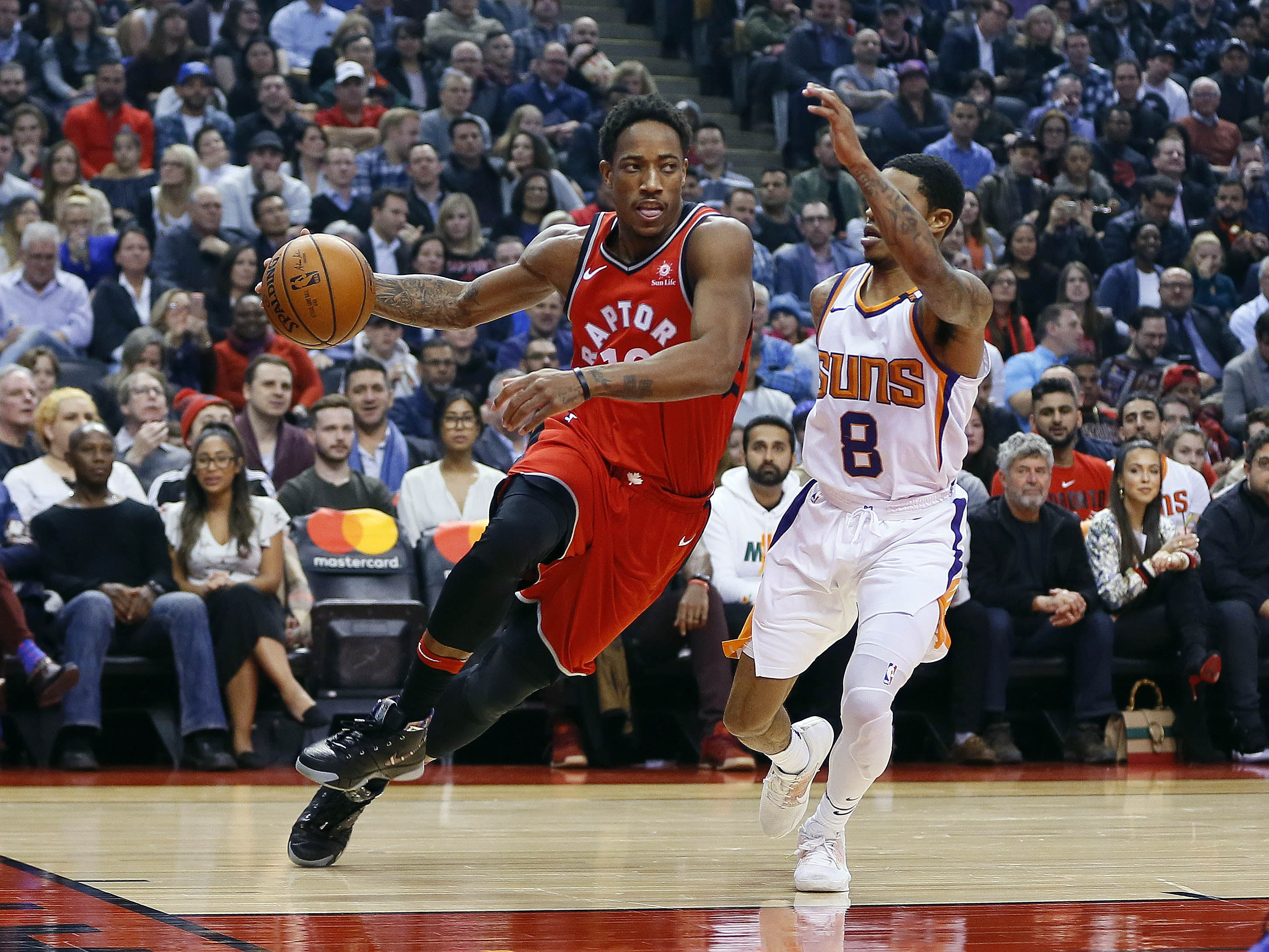
I know, I know. Writing DeMar DeRozan has become a 3-point marksman is a bit of an exaggeration. But considering how much he struggled with that shot entering this season, DeRozan’s improvement from beyond the arc is quite impressive.
The Raptors best offensive weapon has already made 30 3-pointers this season and is easily going to surpass his total of 33 made threes from a season ago. Not only is DeRozan taking the three-ball more, but he’s scoring with it far more efficiently. DeRozan’s shooting six percentage points (32.3) higher on threes compared to last season. A large reason for the all-star’s improved efficiency has been his recent December hot streak, which has seen him convert 14 of his 37 attempts (38 percent) from distance.
If DeRozan is able to keep up his strong shooting from deep, it opens up so much more versatility in his game that makes him practically un-guardable. Closeout when DeRozan’s on the perimeter and he’ll blow right past you to the rim. Leave DeRozan room outside, and he’ll make you pay in the paint. The Compton-native has truly become a Swiss Army knife on offence, in that he’s able to attack a defence in a variety of ways all over the court.
2018 wishlist
Even though Toronto is a top-three Eastern Conference team, there are always improvements that can be made for a playoff regular that’s on the outside looking in at legitimate title contenders. Without further ado, here’s what the Raptors need most to become more of a true title (or at least Finals) contender out East.
Improved rebounding/interior defence from the bigs
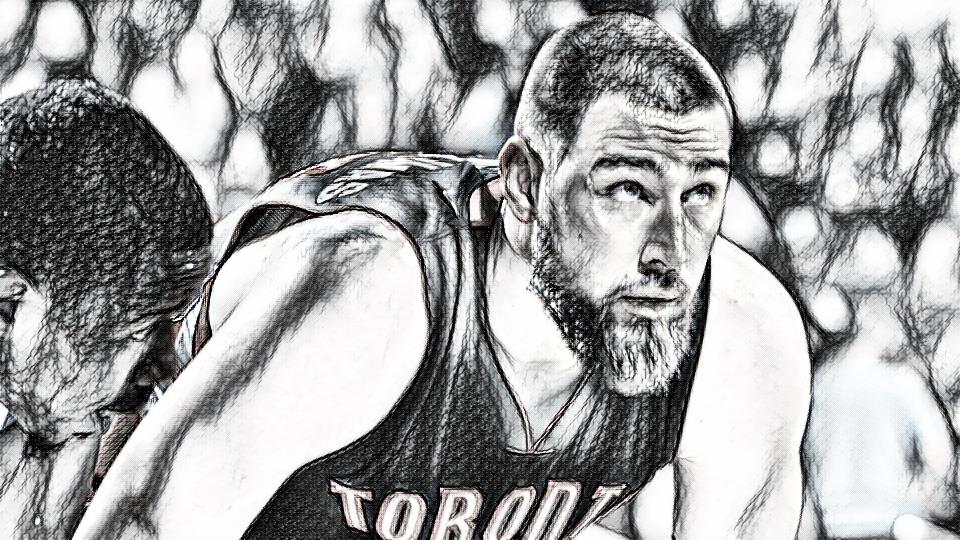
The Raps rebounding is the team’s most glaring weakness. They rank 19th league-wide and an underwhelming 24th on the glass among starting units. Most of that falls on the shoulders of Jonas Valanciunas and Serge Ibaka, who haul in only 13.6 boards per game combined. The Raps starting bigs must improve in that department, especially by the time the playoffs arrive and limiting second-chance opportunities becomes even more crucial.
Acquiring help prior to the trade deadline seems to be the most likely solution to the rebounding problem, but does present its own risks. The current roster has gelled well together this season, so Masai Ujiri must be careful if he’s to move anyone and avoid disrupting team chemistry.
Additionally, it’s tough to find a capable big on the market that won’t demand a large return. The Raptors have been linked to Marc Gasol, but acquiring the Spaniard could take away a lot of Toronto’s rotation depth, which is one of the team’s biggest strengths. The same goes for the Clippers DeAndre Jordan, whose team would likely demand a king’s ransom for his services. Given how nobody out there wants Valanciunas as part of a trade, working out a deal could prove to be challenging. Even so, if there’s anything we’ve learned about Masai Ujiri, it’s that his front office savviness should not be doubted.
Health
Toronto has been blessed with a relatively clean-slate of health for nearly half of the season. Aside from C.J. Miles, Delon Wright, and Lucas Nogueira, Dwane Casey’s rotation has remained intact and has developed strong chemistry as a result. Sure, injuries to Wright and Miles certainly impacted this team to a certain extent, but not negatively enough to directly impact the final outcome of games like the absence of a Lowry or DeRozan would. In seasons past, the Raptors had to play without one of their star backcourt players for prolonged stretches, which obviously was a much greater challenge to overcome. If the team’s backcourt remains healthy, the team will be positioned well when games matter most, especially from a chemistry perspective.
Look at how hard it was for Lowry to reintegrate himself into the playoff rotation alongside Ibaka last season after the former missed a sizeable chunk of time with a wrist injury. That’s the sort of problem the Raptors do not want to have to deal with this time around.
Final thought …
All in all, Casey’s club has had a great start to the season and don’t show signs of slowing down. Whether personnel changes are made or not, the team’s focus should centre around gaining more familiarity with schemes each passing game and growing as a collective unit so that maybe, just maybe, the Raptors can pull off an upset for the ages in the playoffs and finally get past Cleveland (or Boston for that matter…Golden State or Houston is a bit of a pipe dream). A clean bill of health going forward could go a long way in helping that scenario become a reality.