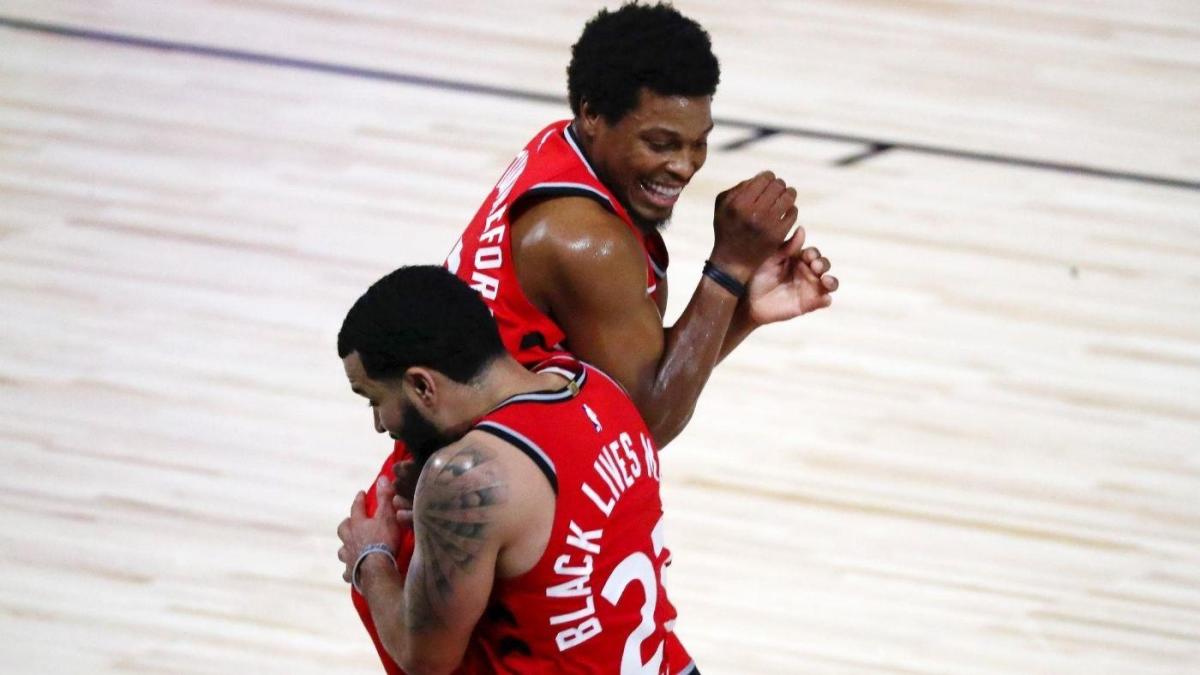
The Raptors lead their best-of-seven playoff series three games to none. Enjoy it, that’s a statement you’ve never been able to make before.
The Incredible OG
The Raptors’ playoff run kicked off in very touching, but also somewhat amusing fashion, as the Raptor loved ones announced the team’s starting five prior to Game 1. I say “amusing” because any doubt as to the type of cloth that OG is cut from was removed the moment his brother provided this incredibly lowkey moment.
Don’t get me wrong, I fully support that introduction. As someone whose level of enthusiasm rises above a three out of ten only on the opening weekend of March Madness or when my fiancée suggests going out for sushi, I’m a firm believer in being exactly who you are and not manufacturing any fake excitement. I just found it hilarious that OG’s introduction confirmed everything I ever thought of the man. To paraphrase the late Dennis Green, “OG’s family is WHO WE THOUGHT THEY WERE!”
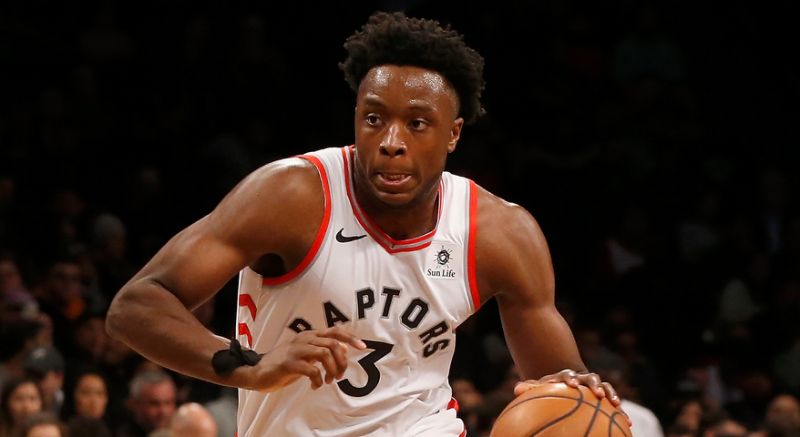
Staying on the OG train, the former Hoosier also provided two other very memorable moments this week. The first came in Game 1, when he rose above three Nets for an offensive board, before spinning and finishing an and-one over TLC.

The second sequence occurred in Game 2, immediately after Rodions Kurucs pasted Anunoby with one of the dirtier screens you’ll ever see.

I have no idea how that’s not a flagrant foul, but that’s a whole other story. Once he had recovered, OG stood up, (my eyes might have been deceiving me here but he seemed to turn a pale shade of green) and I’m pretty sure I heard him yell, “Don’t make me angry, you wouldn’t like me when I’m angry” in the direction of the Nets’ bench. For two of the next three offensive possessions he was no longer the OG we’ve come to know and love, he was The Incredible OG.

The Raps on Defence
Now that we’ve recapped OG’s week, it’s time to get serious and discuss a team that’s now thirteen wins away from defending their Larry OB. Much has been made of the Raptor defence this year and for very good reason. The Raptors finished the regular season ranked second in defensive efficiency, and first by a wide margin in “bubble games”. What makes them even more interesting is that they’ve become one of the top defensive teams in the league while essentially flipping the bird to analytics nerds everywhere (I’m allowed to call them that because I am one).
The three most efficient ways to score are lay-ups/dunks, foul shots, and corner threes. As a result, many teams have structured their defences in order to limit opportunities from these areas. To put it kindly, the Raptors don’t exactly have the shot profile of an elite defensive team. They rank sixth in opponent rim attempts (that’s good), 16th in opponent free throw rate, and dead last in corner threes and total threes allowed (all rankings courtesy of Cleaning the Glass).
This is reflected in their poor location effective defensive field goal percentage (LeFG%) of 53.9% (25th in the league, per Cleaning the Glass). LeFG% assumes that shots from all areas of the floor are made at league average percentages. As a result, this metric shows whether you are shooting (or allowing your opponent to shoot) from efficient areas of the floor. The Raptors are among the worst teams in the league in this metric, which is very rare for an elite defensive team.
Many people with far more qualifications than I possess have theorized on the reasons behind this difference. I won’t get into that at this point, but the potential reasons range from stellar rotations causing poor shooters to attempt the majority of threes, to the aggressive way in which the Raptors close out, to just plain old-fashioned luck. Regardless of the reason, the Raptors were an elite defensive team during the 2019-20 regular season, and will need to be just as good if they plan to repeat as NBA champions.
The oddities of the Raptor defence don’t end there. 538.com recently ran a very interesting piece in which they analyzed the Raptors defence in a unique way. Using Second Spectrum tracking data they measured how aggressive NBA teams were in their defensive coverages. Aggression is measured by how frequently the defence doubles a post-up or isolation, or blitzes a ball screen or hand-off. The 538 crew then used each team’s game-by-game aggression scores to determine how much their defensive approach varied over the course of the season. The article is fascinating, and well worth a read. If you don’t have the time, the Coles Notes summary is that the Raptors defence is extremely aggressive and its style is also extremely variable game-to-game. Both of those characteristics are rare for elite NBA defences.
The 538 piece lists the aggression score for the Raptors defence for every pre-bubble regular season game. I sorted the Raptors defensive efficiency for each game from lowest (best) to highest, and plotted the associated aggression score. It’s very interesting to see that there is essentially no correlation between the Raptors success on defence and how aggressive they were on that evening.
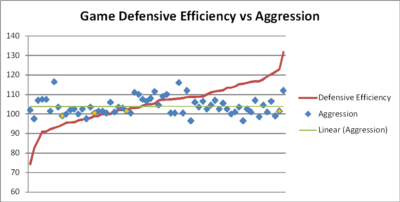
League average aggression is set to 100. As noted above, the Raptors defence is very aggressive relative to the rest of the league. I’ve highlighted the four regular season games versus the Nets in orange. The Raptors were fairly passive versus the Nets in the regular season, sitting right around league average in all four meetings.
The 538 piece comments on the fact that the Raptors will change their style for certain teams and continue to play others in a consistent fashion. For example, the Raptors were passive defensively in their first regular season meeting versus Portland, but very aggressive the second time around. The above graph shows us that Brooklyn was one of the few teams that the Raptors were consistently passive against. I don’t have access to the data that 538 used for their analysis, but my eyes tell me the Raptors have been fairly passive through three games of this series, especially defending ball screens. The above dialogue should be read with the “Brooklyn’s personnel was very different in the regular season” caveat that is attached to any analysis of this series compared to the regular season.
Raptors vs. Nets
Especially when Jarrett Allen is setting the ball screen, the Raptors have a variety of options with differing levels of aggression. They’ve blitzed the ball screen a few times, with mixed success. In theory, pushing the screen as high as possible and then blitzing Caris LeVert could force a dump pass to Allen well outside the three-point line (where he isn’t a threat).
After the Nets jumped out to an early lead in Game 2, the Raptors began switching the high ball screen. This works especially well when they have Serge at the five. A switch is less likely to hurt them against the Nets because Allen isn’t a significant post-up threat, especially considering how scrappy Freddy and Kyle are as post defenders. In Game 2 the switch often occurred when OG was guarding LeVert, which lessens that concern even further. When the Raps switched the LeVert ball screen in Game 2 he often settled for low percentage threes.

If the switch does result in a mis-match, the Raptors are also adept at “scramming” off-ball to get back to the match-ups they want. In the clip below, Gasol and Freddy achieve this through a switch underneath the basket.

As mentioned earlier, the Raptors gave up a historically high amount of corner threes this season. Despite having the top defensive rating in bubble games, they’ve continued to allow a very high percentage of corner threes since arriving in Orlando. This includes the first two games against the Nets, in which 19.5% of the Nets attempts in Game 1 and 17.7% in Game 2 were from the corners. Those two games rank in the 2nd percentile and 4th percentile of all games played this season (per Cleaning the Glass). Game 3 was a slight improvement, with the Nets attempting only 12.0% of their shots from the corners. However, from a Raptors’ defensive perspective that game still ranks in the 16th percentile on the year.
Early in Game 2 the Nets found an abundance of corner threes by hitting Allen in the paint. As the defence collapsed, Allen looked to the corner, locating open shooters on several occasions. A few of these sequences began with a LeVert high ball screen.

One game is always an extremely small sample size, but in this case the stats match what we saw on the floor. In Game 2 the Nets picked the Raptors apart when the screen defender (normally Gasol) attempted to soft hedge or perform drop coverage. The following analysis is based on my review of the Game 2 tape, so your numbers might vary slightly if you performed a similar exercise (but I would expect you to come to a similar conclusion). My focus was strictly on ball screens in which LeVert was the handler.

For the switch coverage, I considered it a possession if the Nets attempted to take advantage of the switched match-up, even if that wasn’t immediately after the ball screen action.
The Drop/Soft Hedge coverage can be further broken down to situations in which the screen defender was Gasol versus a different Raptor.

It isn’t much of an exaggeration to say that everytime Gasol was involved in a ball screen action in Game 2 the Nets got a good look. The Raptors got away with it this time, but might not be so lucky versus a superior opponent.
The Nets weren’t able to find the same success against Gasol in Game 3 for a few of reasons. First, the Raptors were very active off the ball, both one pass away and on the weak-side. In this clip Pascal stunts LeVert’s drive as he tries to attack.

While the next clip isn’t a LeVert ball screen, it illustrates how active the Raptors were on the weak-side of the court. OG is in help-side taking away the pass to the rolling Allen. When the kick does occur OG reacts very quickly and arrives on the catch to discourage the shot. At that point, any advantage resulting from the ball screen is gone and Temple ends up turning the ball over.

It’s also interesting to note that in each of the last two clips the ball screen occurred directly at the three point line. Against a great shooter this could cause problems, but in this case it simply reduces the amount of space Allen has to roll and find space. The location of the screen in these examples is partially due to the fact that the action occurred partway through the possession. However, in Game 3, even when the ball screen occurred early in the possession the Raptors were far more effective in taking away space. In the next clip all five players are in nearly perfect position, giving Allen zero space to roll. Since he’s not a threat to pop, the action was smothered and the Nets had to reset.

Last, but not least, in all three of the Game 3 clips Gasol drops very deep as soon as the ball screen is set. This was also a very important factor in taking away any space Allen had to roll.
Like so much with the Raptors, the effectiveness of their ball screen coverage in Game 3 required everyone on the floor to play as one. This is what we’ve come to love about them and what makes this team so fantastic to watch.
The work from here on out is only going to become more challenging for the defending champs. Despite being more formidable in Game 2, the Nets are one loss away from heading home. However, with a likely meeting with Boston in the Eastern Conference Semi-Finals, the defensive game plan and adjustments as the series drags on could mean the difference between advancing and going home. For a team that has been so unique, but also elite, in their defensive approach, it will be a fascinating storyline to follow.