“When you look at the championship-level teams, those are the teams that shape tendencies around the league.”
That’s what Darko Rajakovic told me when I talked to him last season about stylistic evolution in the NBA. For as self-evident as the observation may seem, when you’re in the midst of a stretch that’s seen a new champion crowned in each of the last seven years, a span that’s produced 11 different finalists, a time when the league essentially has a new crop of trendsetters every year and tactics change at warp speed, it’s not always obvious which way the prevailing winds are blowing.
At the time, Rajakovic was talking about the defending champion Boston Celtics.
“Everybody can shoot, everybody can switch one through five. They won the title, and now people are looking more for those types of teams,” he said.
It’s not like last season’s Toronto Raptors (or this year’s, for that matter) had any hope of playing like those Celtics, but Rajakovic was still one of a handful of coaches who told me that the rest of the NBA’s challenge involved either mimicking or countering what Boston had built. It was no coincidence that leaguewide 3-point attempt rate spiked significantly in 2024-25 after five years of relative stability.
And yet, for as influential as those Celtics were, for all last season’s talk about the necessity of keeping up with them, few teams actually resemble them stylistically right now. For those who feared the encroachment of Mazzulla-ball, the 2025 playoffs offered something of a corrective. The teams that reached the Finals ranked 17th and 20th in long-range frequency, and the conference foes that came closest to knocking those Finalists off (New York and Denver) ranked 28th and 30th. Now, a month into the 2025-26 campaign, the Rockets have the top-ranked offense in the NBA while hoisting the league’s lowest volume of threes. Rajakovic’s Raptors rank seventh in offensive efficiency – including third in halfcourt scoring – despite sitting 27th in 3-point attempt rate.
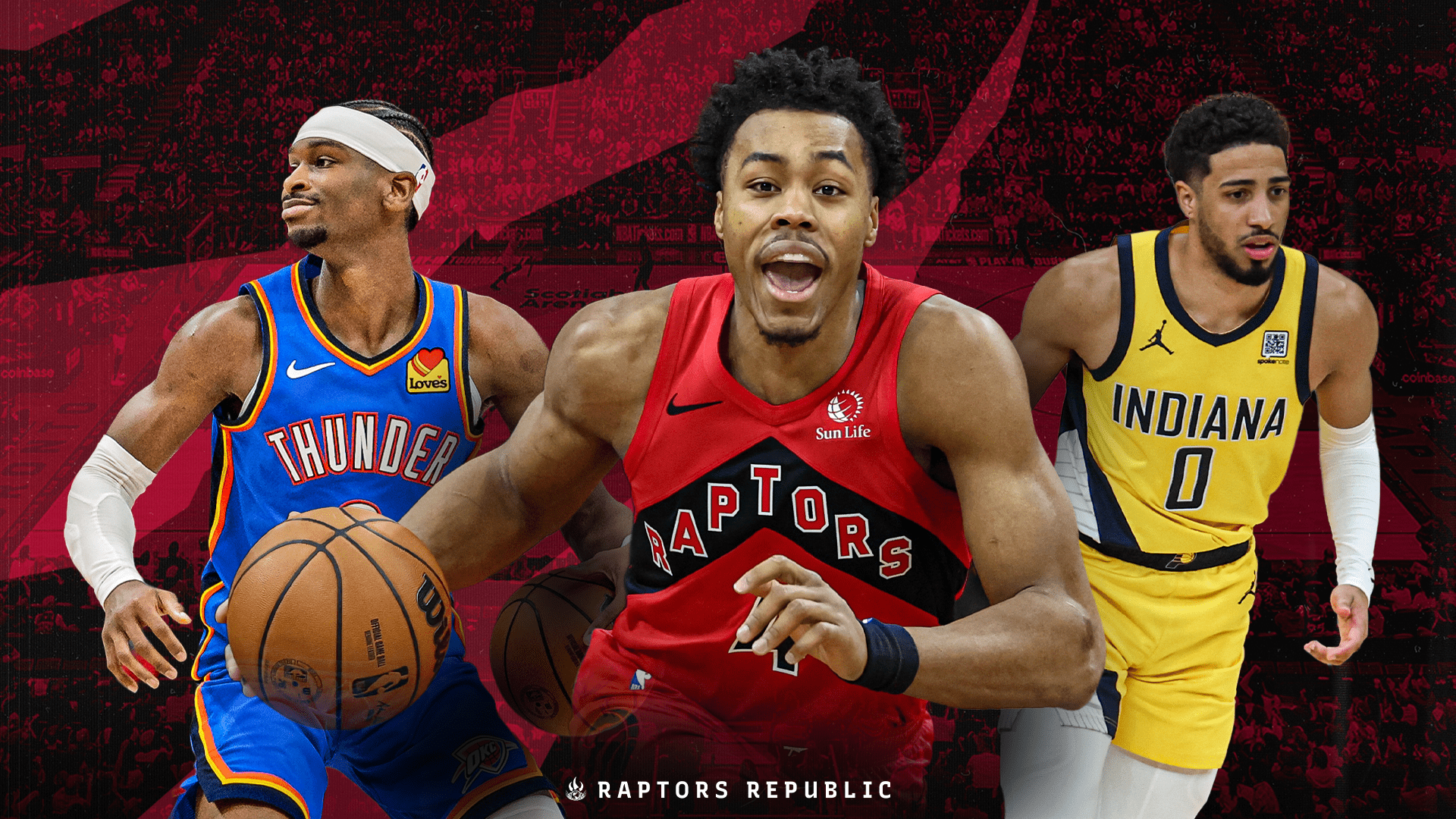
Crucially, the rest of the league watched the Oklahoma City Thunder win the title and the Indiana Pacers push them the distance in the Finals while playing almost nothing like the 2024 champs. On top of the stark differences in offensive process and shot diet (way more drives, way fewer threes, way more paint shots), the Pacers and Thunder both played lightning fast, whereas Boston was one of the slowest-paced teams in the league.
At the defensive end, their respective schemes hinged on full-court pickups (Indiana), swarming help from all directions (OKC), and turnover generation born of relentless physicality and ball pressure (both), whereas the Celtics by design forced fewer turnovers, committed fewer fouls, and double-teamed less frequently than any other team. (The Pacers essentially abandoned their own attempt to adopt that help-averse philosophy a year prior, when it led to a comically high opponent rim rate.)
Whether due to recency bias, a sense of attainability – namely regarding Indiana’s success, since that team more than any other was perceived as outperforming its true talent level – or a combination of the two, a new tactical paradigm has taken root that partly explains how the Raptors and a slew of other teams have been operating this season. Across the NBA we have offenses playing at breakneck pace, while defenses bump and grab, hunt turnovers, and pressure the ball all the way up the court.
NBA basketball being a zero-sum game, not every team is benefitting equally from those play-style shifts. But before we get into specifics of where the Raptors stand in the new landscape, let’s take a big-picture look at the landscape itself:
After seeing the Thunder and Pacers thrive as last postseason’s second- and third-fastest teams following opponents’ made baskets (per Inpredictable’s average-time-to-shot tracking), more teams are making a point of pushing the ball across the timeline in a hurry. NBA teams on average have shaved nearly a half-second off their average offensive trip, leading to nearly two additional possessions per 48 minutes. If the current pace holds, it’ll be the fastest the league has collectively played since the 80s.
But while the run of play has gotten faster, incessant whistles are slowing games down. Turns out, having a bunch of teams defending with Thunder-like playoff physicality, while being officiated with regular-season discernment, has led to a metric ton of fouls. Last season, the Raptors sent opponents to the free-throw line more than any other team, at 25.2 times per 100 possessions. This season, the NBA average is 25.3, which if it holds would be the league’s highest mark in 15 years. That’s the biggest reason leaguewide offensive rating is up a full point from last year despite effective field-goal percentage holding steady and turnovers skyrocketing.
Of course, the reason for the spike in turnovers is the aforementioned uptick in defensive aggression. On the heels of a season in which the eventual champs authored the greatest turnover differential of all time, defenses have pushed the league’s steal rate to its highest point in over 20 years. Part of that is due to broader integrations of OKC’s frenzied and unpredictable help principles. And part of it is because of a large-scale adoption of the full-court press that Indiana showcased throughout the postseason.
Pace and ball pressure are things Rajakovic has been preaching since he arrived in Toronto, so it’s not like this stuff is entirely new to his Raptors. But you can see the way he’s been emboldened to push his preferred style to the limit after witnessing such convincing proof of concept last spring.
Even in a league where just about everyone wants to run, the Raptors stand out. No team even comes close to their 20.5-percent transition frequency – the gap between them and the second-ranked Bulls in that category is equivalent to the gap between the Bulls and the 11th-ranked Hawks – nor to their absurd 41.8-percent rate of turning defensive rebounds into open-court chances (league average: 30.3 percent), per Cleaning the Glass. They rank just 23rd in transition scoring efficiency because their decision-making and finishing in those scenarios is liable to go haywire. But they still slot in at 13th in estimated transition points added simply because of how often they get out on the break.
They aren’t exactly the Pacers, because they don’t have Tyrese Haliburton – one of the best hit-ahead passers and most judicious high-speed decision-makers in the history of the NBA. And their halfcourt offense is ponderous by comparison. But Scottie Barnes has been a good enough orchestrator in space to help the Raptors achieve (for now) a similar balancing act of pushing tempo and passing a lot while still taking good care of the basketball, with the league’s seventh-lowest turnover rate.
Sustaining all that will be hard. This stuff is hard! It requires top-tier conditioning and relentless motor and a commitment to floor balance on a full team level. Would it surprise you to learn that the Raptors are the only team in the top 10 in offensive pace who currently own a top-10 offensive rating? Or that they’re doing that while ranking as the league’s second-best transition defense? Can they keep playing this way without getting burnt out?
They might aid their own cause by further dialing things down at the defensive end, where they’re asking their guys to cover more ground than any team besides Portland. Their forays into full-court pressure have largely been unsuccessful. They don’t really have the type of defenders who possess the lateral agility, balance, and instincts required to both press and contain the ball, so their attempts to do so have led to a lot of blow-bys and needless backcourt fouls. And with Jakob Poeltl’s back injury looming over the start of the season, Toronto hasn’t always had the back-end defence capable of cleaning up the messes resulting from extended pressure. Those issues have also been present in Toronto’s penchant for springing blind double-teams, jump-switching, and going chest-to-chest with ball-handlers in the halfcourt.
In ostensibly doing a full 180 after an unsightly 1-4 start – ranking second in defensive rating while going 9-1 since – they’ve eased some of their most aggressive tendencies. The rotations behind their point-of-attack pressure have gotten significantly smoother, and their rim protection has improved with a healthier Poeltl in the fold. But their defense is still riddled with red flags, stemming at least in part from their scheme.
Yes, they’re forcing a lot of turnovers, but they have the NBA’s third-least efficient defensive shot profile, per Cleaning the Glass, allowing the second-highest rim rate and eighth-highest volume of corner threes. That’s while continuing to foul the bejeezus out of everyone and struggling on the defensive glass. They’ve been bailed out by opponents shooting just 32.3 percent from deep against them.
Outside of Barnes and a couple of other guys on the roster, I’m just not sure the Raptors are particularly well-suited to a hyper-aggressive style of defense, and I wonder if that will be reflected in further adjustments moving forward. Fortunately, Rajakovic has never struck me as a stubborn coach, even though he’s tried on a couple of occasions to wedge a square team into a round stylistic hole. He deserves credit for the subtle tweaks he’s already made this season, and some of the ways he’s proven willing to diverge from the zeitgeist.
On top of scaling back some of the pressure, the Raptors have de-emphasized offensive rebounding at a time when the league is going bananas for it. They’ve seemingly done so in the interest of aiding their transition defense, which as mentioned earlier has been stellar. Even though that’s been proven to be something of a false binary, I think it makes sense for Rajakovic to look at this Raptors team and deem it less capable of hammering the offensive glass while also suppressing opponent transition chances the way that, say, the 2021-22 version was able to.
My overarching feeling is that it can be misleading to view any one season’s results as referendums on what does and doesn’t work in a rapidly changing league. Just as teams didn’t have to mimic Boston’s model to win big, there’s no reason to think conservative defensive schemes can’t still be hugely successful. Or that playing at a methodical pace is inherently limiting, or that tightly structured offense is inferior to the read-and-react systems currently sweeping the league.
Every season, every postseason, every contender, and every champion is its own unique organism. The 2025 Thunder shared some roster characteristics with the champs that preceded them – an army of skilled, switchable wings flanking a floor-spacing, rim-protecting 7-footer – but still diverged philosophically and stylistically from those Celtics, who, for their part, couldn’t have been more different from the title-winning 2023 Nuggets, who themselves had very little in common with the 2022 Warriors, who were wholly distinct from the 2021 Bucks, and on and on and on. This new-champ-every-year trend may well end in 2026, but it’s not like anyone’s going to be out-Thundering the Thunder anytime soon.
Trends obviously become trends for a reason, and those who choose to ignore them often get left behind, but every team needs to run its own race. Mark Daigneault, whose Thunder are running laps around the league with a perfect harmony of talent and tactics, grasps this as well as anyone.
“All of our tactical decisions are a byproduct of who we have,” he told me. “It’s not like we’re on the drawing board saying, ‘what’s going to be the next big trend?’ and trying to get out in front of that. It’s more that we’re on the drawing board trying to understand our players, and how to best leverage their strengths, and doing so without boundaries. If it’s something that’s unconventional, we’re willing to explore that. But it’s always in pursuit of what’s best for our players.”
It’s hard to build toward a future that’s always changing, which is why it’s so important for teams to identify how they want to manifest their own vision of tomorrow. I think we’re starting to see a hazy outline of that vision from the Raptors. They might get distracted at certain points by some of the paths their peers are laying down, but their eyes tend to return to the road they’re on.
The question of where the NBA is headed stylistically is one I’ve been pondering for a while, and at this point I must admit I have no idea. All I know is that we’ll continue to see postseason breakthroughs that pump trendy new formulas into the league’s water supply. And that ultimately, the coaches who squeeze the most out of their rosters will still be the ones who understand their players the best.