“Speed kills.”
A simple yet stark reminder that anyone who’s learned to drive has heard countless times.
While going fast is undoubtedly exhilarating (albeit not that likely on any major Toronto road or highway, given the never-ending traffic), it’s also true that higher speed often equals greater risk.
I personally learned that lesson right after buying my first car.
Before you ask, it was nothing serious — the only injury suffered was to my ego. I had hardly driven since getting my licence, so a midnight cruise after bringing the car home felt right. The longer I drove around the empty neighbourhood streets, the more comfortable (overconfident) I felt, and the more pressure my foot applied on the accelerator. Windows were down, music was up and there was a satisfying breeze wisping through my hair. It felt good.
Content with my nighttime drive and still feeling bold, I opted to ignore the brake pedal when entering my building’s parking garage, only to misjudge the distance between my car and a divider. Within the blink of an eye and mere hours after my first (young) adult purchase, the driver-side mirror on my 2013 Hyundai Elantra was on the ground in my rearview. I didn’t tell my parents the truth about that until many years later.
The experience — in a roundabout way — both reaffirmed my enjoyment of going fast and also taught me the value of slowing down.
None of which should matter in a basketball context, right? Because going faster seems to make sense naturally?
Teams around the NBA appear to think so. The league average for pace (100.3) is tied for the highest it’s been in over 30 years, while time-to-shot (11.5 seconds) is currently at an all-time low in more than two decades of tracking (per Inpredictable).
Last year’s Toronto Raptors were all about moving fast. Ninth in pace, second in average speed (4.42 m.p.h.) while posting the fourth-fastest time-to-shot (11.1 seconds) and seconds per possession (20.2). They were all in on the trend.
Playing faster has been a hot topic this season, for better or for worse. Lauded for encouraging breakneck action and also lamented for its presumed role in the NBA’s laundry list of injuries. Which begs the question: how fast is fast enough before the wheels fall off?
Or in my case, the driver-side mirror.
Whatever the ideal pace was, the speedy 2024-25 Raptors weren’t able to figure it out — not accomplishing much while zooming to a 30-52 record. Often, they were trying to run away from set defences, or more accurately, from having to operate as the NBA’s sixth-worst halfcourt offence (ranked 28th in halfcourt frequency), but ultimately they gained very little from that strategy. They were fast, but they still posted the league’s 24th-ranked net rating while committing the seventh-most turnovers and leading the NBA in fouls. There are downsides to speed.
And the upsides didn’t help all that much, anyway. Toronto raced to the third-most frequent transition offence yet ended up sub-10th percentile because of a woeful 56.3 effective field goal percentage (29th in the NBA) and the fourth-worst scoring rate.
The wheels (and mirror) most definitely fell off.
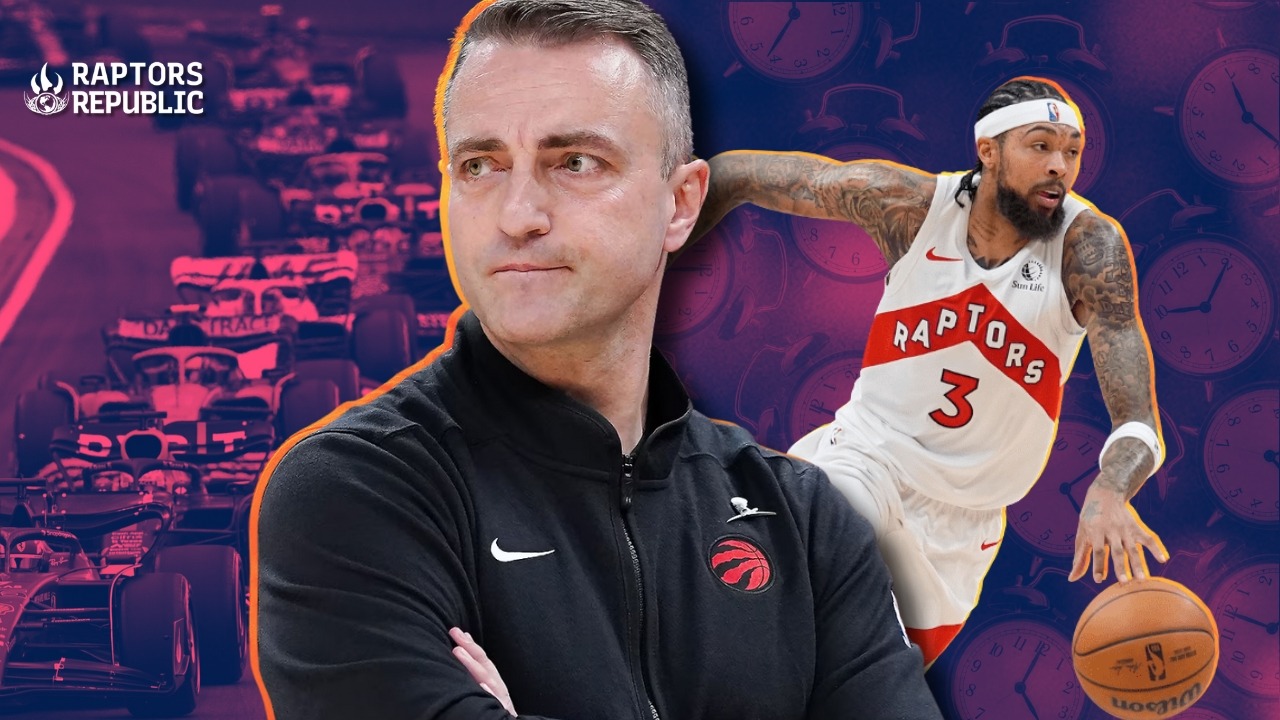
And this is why head coach Darko Rajakovic has been working to avoid the divider — like I couldn’t — for some time, in preparation for the 2025-26 campaign. A dilemma he previously referred to as the “speed paradox.”
If you’re wondering what that means (like I was), look no further than our very own Samson Folk for an explanation. I first heard the phrase during one of his post-game questions, and upon failing to find anything on the topic myself, I asked our resident ball-knower to enlighten me — which he did, as he so often does.
The speed paradox: When you’re at 100 per cent speed, you lose the ability to be accurate.
How much accuracy drops off largely depends on the team/talent, but for the Raptors, it became evident that anything close to all gas, no brakes was clearly too fast. So, in their own roundabout way, the Raptors also learned the value of slowing down thanks to their version of a broken mirror and a battered ego.
And now we’re seeing a much more measured approach this season because of it.
That’s not to say it’s been a complete about-face, as Toronto remains a high-octane defence — leading the league in average speed on that end (4.30 m.p.h.) and tied-second for distance travelled defensively (8.50 miles per game). Even as the team has scaled back the high pick-up ball pressure approach of late, they still rank top five in speed and distance, while continuing to be an elite transition defence (93rd percentile).
It’s very much how Rajakovic wants his guys to operate. Turning defence into offence and attacking tilted opposition, with a sense of urgency, has persisted as a priority — the Raptors rank top five in the NBA for time-to-shot off misses and turnovers.
Even with a transition offence that still isn’t all that efficient this season (51.7th percentile), ranked 15th in points per possession (1.12) and scoring rate (51.4 per cent), their commitment to running and gunning (third in frequency and attempts) has allowed them to volume their way to generating the most fastbreak points per game (20.9) in the NBA.
So going fast hasn’t gone away entirely — and it shouldn’t. There’s merit to playing with pace, especially in today’s NBA. But each team has its breaking point. And what has changed is the Raptors’ ability to recognize theirs, knowing when to press on the accelerator and when to ease off and slow down. Especially during their recent hot stretch — going from sixth in pace through a 1-4 start down to 20th during their 12-1 run.
The Raptors’ time-to-shot after makes has dropped from seventh last year to 17th this season, and even on offensive rebounds, it’s plummeted from second to 14th. There’s been far more patience and nuance to the approach. It’s no longer “hit the gas” irrespective of makes or misses to find open lanes, as these Raptors have been far more willing to navigate through traffic. Showing confidence and comfort in operating later into possessions and against set defences.
Last year’s squad took 40 per cent of their shots within the first nine seconds of the shot clock, and while that number is only slightly down in 2025-26 — and they’re leading the NBA in attempts between 22-18 seconds for a second consecutive season (because of their consistently high transition frequency) — the team has noticeably levelled up when time is ticking down.
In shots that are defined as “late” by the NBA (between 4-7 seconds left on the shot clock), the Raptors have jumped from 22nd in frequency last season to sixth, with a near-five percentage point increase to a 50.3 effective field goal percentage.
This is as much a credit to Rajakovic for recognizing the strengths and weaknesses of his roster after the addition of a slow-it-down savant in Brandon Ingram, as it is to the forward himself for living up to his billing. Ingram is one of just 15 players this season averaging two-plus attempts per game in that 4-7 second window — twice as many as any other Raptor — and heading into Monday’s game against the Cleveland Cavaliers, he was fourth in effective field goal percentage (52.9) among that group.
The Raptors now have a player who excels when possessions hit bumper-to-bumper traffic, and good coaching not only understands that, but allows it to co-exist within the system as Rajakovic has.
Which is what’s arguably been most interesting about the Raptors’ willingness to play slower. It’s that it hasn’t made them sluggish decision makers. They remain within the top 10 for the shortest time of possession (20.2 seconds) and fewest seconds or dribbles per touch. While certain players like Ingram, Scottie Barnes and Immanuel Quickley have been empowered to operate on cruise control to generate advantages when needed, guys around them are still adhering to Rajakovic’s 0.5 decision-making philosophy.
The Raptors aren’t a team that wants to stay fast anymore, but they are damn-sure willing to move fast. Think acceleration versus speed. Rather than constantly trying to be at maximum output — because they lose accuracy, A.K.A. the speed paradox — the Raptors are picking when to speed up and when to slow down, effectively toggling between sports mode and eco throughout the ebbs and flows of a game.
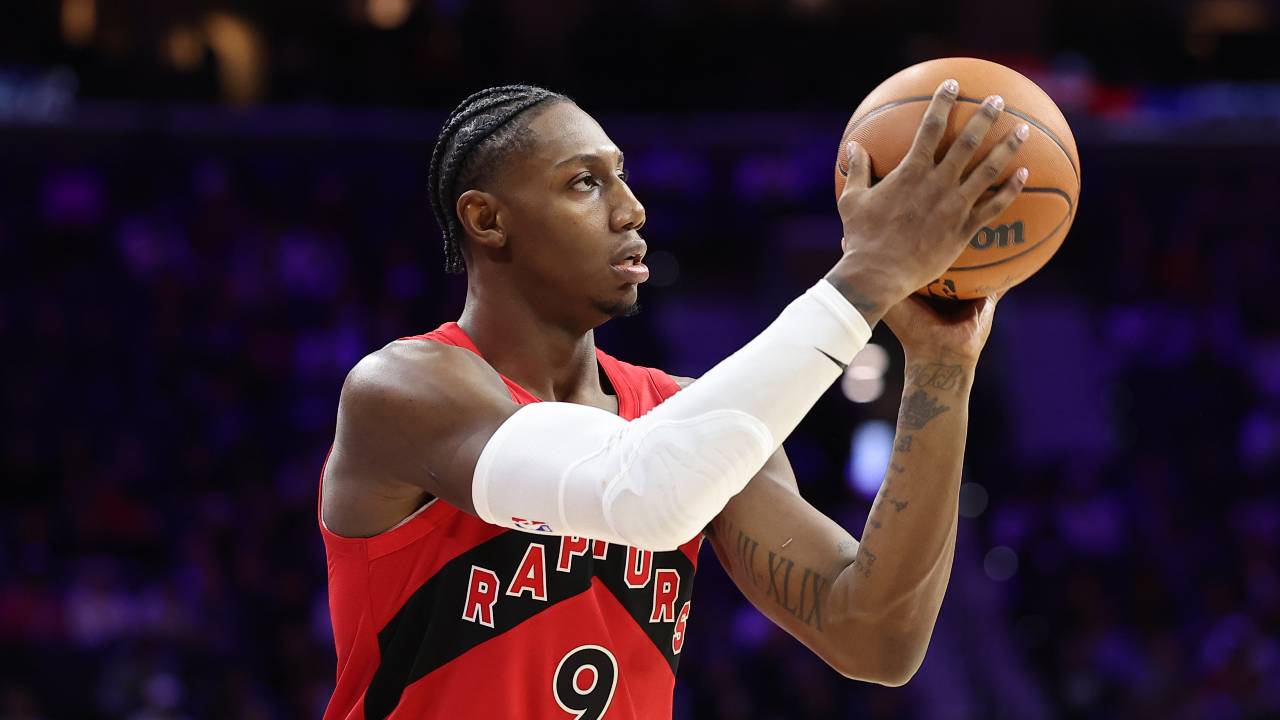
Consider RJ Barrett, who ranks bottom half on the Raptors in average speed but is one of the NBA’s most productive cutters this season. He picks when to be fast, and it’s the quickness of his decisions and acceleration of his movements that allow him — and the Raptors, who rank fifth in cutting frequency and sixth in points off cuts — to create success.
All of which has done wonders in turning around what was one of the NBA’s worst halfcourt offences last season to the No. 2-ranked attack on first-shot halfcourt possessions (which exclude offensive rebounds) this year, and top five halfcourt offence overall. Good teams have identities — the Raptors remain a bottom-three team in halfcourt frequency just like last year — but great ones can read and react to what’s in front of them and execute outside of their comfort zone.
There’s no doubt that playing fast is fun (and effective), but the reality is that most teams can’t do it constantly without wearing down or hitting a couple dividers along the way. (Speed limits exist for a reason!) And while the league has focused its efforts on getting better at playing fast, the Raptors have done the opposite. They’ve known how to perform at high speed, but also learned it’s not sustainable (at least for them) to be at top gear for anything close to a full 48 minutes. Or, put another way, the Raptors are keeping the benefits of speed while ameliorating the downsides of half-court offence. Largely via Ingram.
Rajakovic and his Raptors have figured out their ideal pace of play — pressing down and easing up on the accelerator as necessary — and they’re keeping the car intact because of it. Driver-side mirror included.