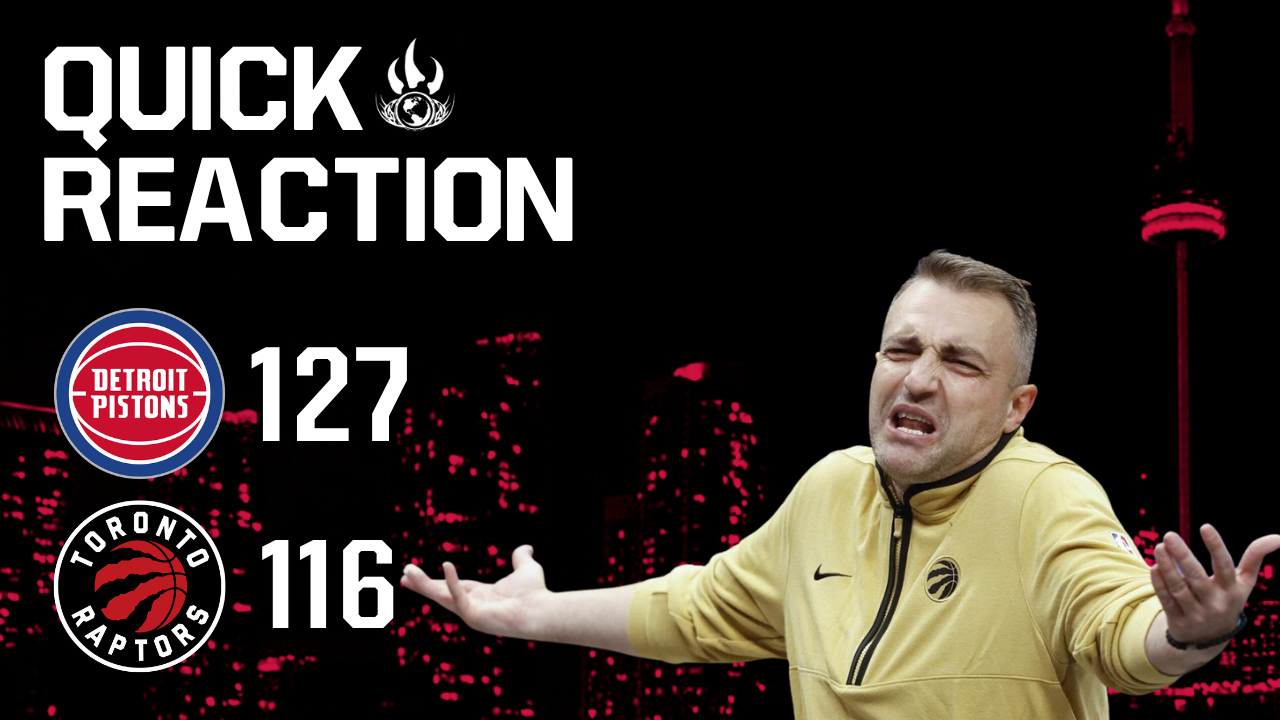

Over the last 4 games coming into this one, the Raptors have been playing with the ball in Scottie Barnes’ hands far more often. A 3-1 stretch where the Raptors have put up great offensive numbers (1.53 ppp v Orlando, 1.23ppp v New Orleans, 1.02ppp v Los Angeles, 1.32ppp v Utah) with Barnes matching the team step for step and stuffing the stat sheet to the tune of 18.8ppg, 12.3apg, and 6.5rpg. They’ve played very fast. There are two elite halfcourt performances included in these games (Orlando & Utah) and the Raptors were hoping to test out their interim lead, guard/point forward against the Detroit Pistons, who are not only the second best halfcourt defense in the NBA, but they’re also elite defending in transition.
In terms of early play? The Raptors went painfully slow. The Pistons sat on their early actions (away, zoom, option screens, you name it) hand fighting and battling to take away first options and move the Raptors deeper into the clock. It worked extremely well. It took the Raptors over 7 minutes of game time to make their first field goal – an RJ Barrett layup in transition after a blind-double and steal on Jalen Duren. It jumpstarted a meaningful run for the Raptors to bring them back within 2 points.
“As funny as it sounds, it’s extremely simple. Just throw the ball to the open man, right?” J.B. Bickerstaff told me before the game of how to avoid turnovers against the Raptors. “That’s the way they defend, and I’m not being short, they literally try to pinch and bring as many bodies to the ball as they can. So, if you just pass the ball to the open man the game becomes really, really easy. Obviously, it’s easier said than done, and that’s why they’re so good at it. But your spacing matters in that… If you’re below the pinches, it’s hard for that guy to make the read to you. So, we talked about our spacing, we talked about making decisions earlier – before you get into the traffic where they do have great length and athleticism. But the spacing and the willingness to just get off the ball are the two things that you’ve got to focus on.”
By the end of the first quarter the Raptors were down 6 and lucky they weren’t down by a more substantial margin. Their lefties, Barrett and Collin Murray-Boyles, were huge motivators in keeping them close. Murray-Boyles a very affecting defender and rebounder, Barrett a day labourer carrying the offense to and fro. His willingness to brutishly navigate the packed Pistons was the Raptors best offense to kick things off. The Raptors desperately needed resilient drivers. The Pistons were sitting on the pass. Begging the Raptors to make scorers of themselves and to see where the cards would fall.
The Pistons couldn’t stop turning the ball over. The Raptors couldn’t stop turning the ball over. Both teams were losing the grip on nearly a quarter of their possessions. Only Toronto had it worse because their shot making was nearly as bad as their ball control. The only redeeming offensive category they found solace in was offensive rebounding. As the half wore on, the Raptors found their pace overall. The turnovers they were creating were sending them sprinting, and it allowed them to avoid the half court – and they needed that, as their half court offense was beyond dreadful (.86ppp in the first half).
A will vs. skill battle. The Raptors fighting their way into the paint by any means with extra possessions and gumption. The Pistons, simply making far more jumpers. 61% from downtown vs. 20%. Somehow, the Raptors were only down by 5.
Checking back in on Barnes’ point guard duties? He had a tremendously difficult time dealing with Ausar Thompson and Tobias Harris as his primary defenders. Not only were those two quite disciplined and as physical as necessary, but the Pistons defense as a whole was attuned to what was happening at the point of attack. He had 1 point at the half and a team low -11. Although, he did have 6 assists and made quite a few nice passes toward the rim to fuel some layups.
The second half began with a lot of the same limitations hanging around the Raptors as the first. Both the Pistons and the Raptors were looking to make high-low home run reads, but the Pistons were coming along more successfully as counters to the Raptors defending higher up the court. For the Raptors, they seemed to be trying it to navigate their lack of dribble penetration. Forcing tight window passes to reach the paint in the only way they could. This led to the Pistons easily outpacing the Raptors across the front half of the third quarter and taking their lead up to 23. A 27-8 run. A punch in the mouth.
While all this shooting was going on, Duren was running roughshod in the paint. 27 points on 10-11 shooting. I can’t say for certain that he remembered Jakob Poeltl’s massive, 20+ point, 18 rebound, 5 assist performance against him last time, but this was quite a response.
In the trudge towards the final buzzer the Raptors found a couple things that worked. A wedge screen for Ingram, some more pitch plays for Barrett. Barnes pushed even harder and tried to create while sprinting up court. A helter-skelter run of play by the bench that crept close to faux comeback range. None of it was enough though. From the start of the game, the Raptors were behind in creation. They were behind in shot making. They were, frankly, far worse at offense. The Pistons shot better than them at the rim, in the mid-range, and from downtown. They couldn’t get out from under their own limitations.
Have a blessed day.