The following is part of Raptors Republic’s series of pieces previewing the season for the Toronto Raptors. You can find all the pieces in the series here.
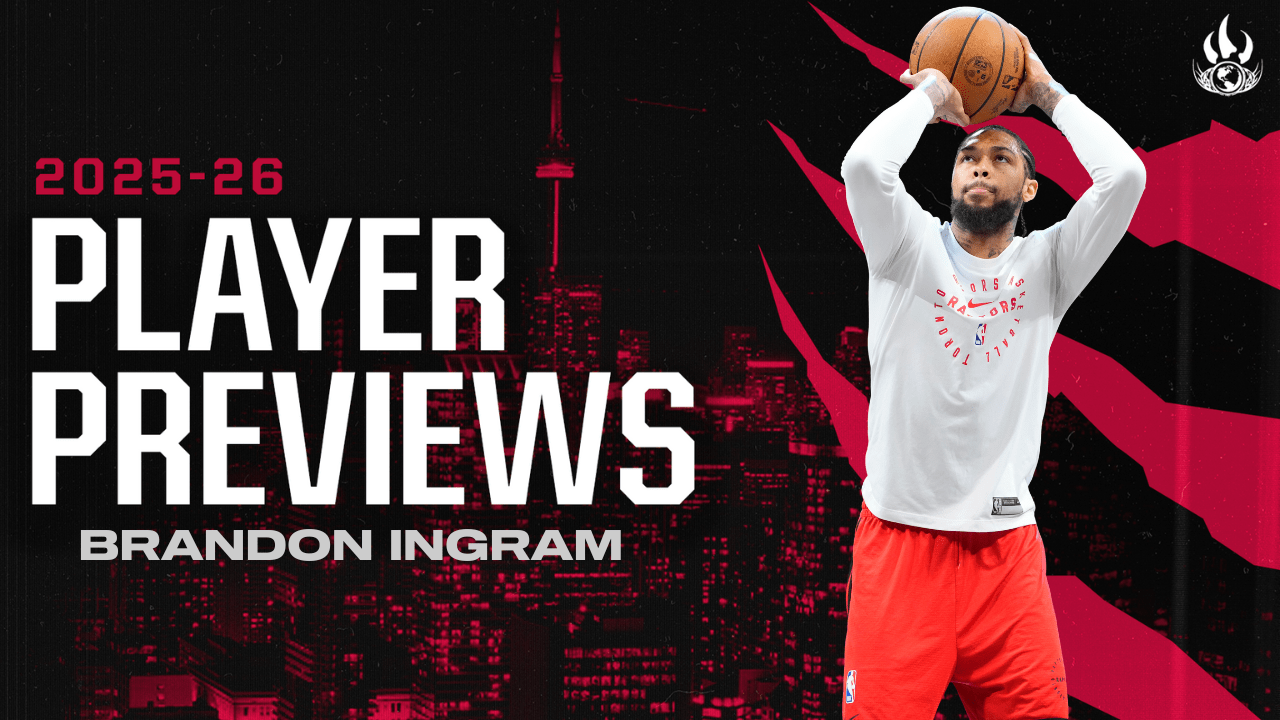
As the Toronto Raptors look to take the next step this upcoming season, there may be no factor that could swing the team’s success more than Brandon Ingram.
The wiry, six-foot-eight isolation scorer is set to suit up for the egalitarian, ball-movement-focused team for the first time after being acquired at the 2025 trade deadline for Bruce Brown, Kelly Olynyk, a 2026 first-round pick, and a future second.
The crux of Ingram’s potential impact rests on a) How his style of play will fit into the Raptors’ offence and b) How that fit will impact those around him.
While their defence picked up over the second half and wound up league average by the end of the season, the Raptors’ offence was in disarray. Really, it has been for some time now. Toronto finished 26th in offensive rating in 2024-25 and has been 25th or worse in halfcourt offence in each of the last four seasons. They have been starved for live-dribble creation and rim pressure for some time.
For a Raptors’ offence predicated on equity and sharing the ball, there was a huge gap in the difficulty of player’s jobs last season. Certain role players were fed a steady diet of open corner 3s and looks at the rim off cuts and in transition – think Ochai Agbaji and Ja’Kobe Walter. Meanwhile some of the team’s young stars (Gradey Dick early on before he burned out, Scottie Barnes, and RJ Barrett) had to shoulder a creation load that was beyond their capabilities. Well, now they have a player who is a far superior self-creator to whom they can defer.
As Raptors Republic’s Samson Folk has proposed, inserting Ingram into the Raptors’ offence could potentially take some of this burden off players like Barnes and Barrett, allowing them to operate in ways that better play to their strengths. If Ingram can take more of the difficult shots and open space on the floor with his gravity, Barnes and Barrett could score more points on greater efficiency off playtypes better suited to their abilities.
And Ingram is a professional tough-shot taker and maker. A “bucket getter,” if you will. Able to craftily slink his way to his spots, rise with ease and nail silky jumpers, he’s among the best mid-range and isolation artists in the game.
Ingram has placed top five in mid-range attempts per game in each of the last five seasons, finishing second to only DeMar DeRozan last year (though the sample for Ingram was small due to injury) and has been 70th percentile or better in long-mid range accuracy over the same span.
During his first half-season in Toronto, Barrett made a killing feasting on cuts, in transition, and off drives. If he is once again put in a better position to carry his bowling ball-esque momentum towards the rim off stampede cuts and when curling around handoffs, rather than from a standstill, it’s reasonable to expect his efficiency to tick back up.
Barnes averaged a career high 3.1 mid-range shots and 2.2 isolation possessions last season. While it’s good to have those shot types in his bag, he’s undoubtedly more effective when using his strength to bully his way to the rim or his athleticism to run opponents out of the gym.
This could all have a cascading effect down the roster. Defences loading up on willing and capable passers like Ingram, Barnes, and Barrett should open shooters like Quickley, Dick, and Walter up to launch from deep. Maybe the Raptors will even be an above-average 3-point shooting team for the first time since ‘the Tampa tank.’ Ingram will help with this too; he’s shot 37 percent on over four 3-point attempts per game over the last three seasons. This includes a career-high 6.4 last season, almost all of which were from above the break. Even though he’s traditionally been criticized for not shooting frequently enough from deep, he’ll still be a huge upgrade in Toronto. Meanwhile, better spacing and the pull of Toronto’s stars could open non-shooters Collin Murray-Boyles and Jonathan Mogbo for corner-crashes and gut cuts galore.
Ingram has the ability to both make reads out of drives and make difficult passes to set up teammates for these kinds of looks too.
Of course, Ingram first must play well himself for all of this to align. But given his track record – 23.0 points on 57.6 percent true shooting with 5.5 rebounds and 5.2 assists over his six seasons in New Orleans – there’s no reason to think that he can’t eat up possessions as a primary ball-handler, facilitate for his teammates out of drives, and make difficult shots at an above average clip. Even though Toronto runs a pass-happy offence, primacy still exists. Last year’s players were less qualified for that role than Ingram.
That bring us back to the first question. How will a player who commonly ranks among the league leaders in isolations fit into a Raptors’ offence that tied for last in isolation possessions last year? Ingram tends to slow down and flatten out. Will he adjust and play point-five basketball, making quick decisions and moving the ball to carry advantages, or will the system Darko Rajaković has worked hard to implement over the previous two seasons mold itself to accommodate Ingram’s tendencies?
Ingram really isolates a ton, more than any other player on the Raptors and almost as much as the entire team did on a per game basis last season. And he hardly cuts, registering less than 10 total in 18 games. Alternatively, The Raptors ranked third in the NBA in cutting frequency.
It stands to reason that Ingram’s penchant for isolating will result in more iso possessions. He’s a nine-year veteran and habits don’t just change on a dime. The Raptors will ask him to bail them out with the shot clock running out sometimes, and his ability to salvage a blown-up play with his shot making is valuable. But it’s also reasonable to presume that some of the Raptors’ offensive principles will rub off on Ingram. Rajaković certainly hasn’t had any trouble getting the rest of the roster to buy into his philosophies. During his last full season Ingram still finished a possession with a cut only 26 times, but averaged 1.46 points per chance, ranking in the 78th percentile.
Tough mid-range isolation shots are a handy tool to have in the bag when needed, but if Rajaković and the Raptors can nudge his shot diet ever so slightly towards more spot ups and cuts, the resulting efficiency bump could take Ingram’s game to the next level. As we’ve seen with RJ Barrett, a change to a more fitting context can work wonders.
This is all hypothetical. Until the rubber meets the road, we can’t be certain how Ingram’s game and the Raptors’ offence will co-mingle and ultimately come together. In a worst-case scenario it could be like oil and water with all the consternation about players occupying similar areas of floor coming to life. But he also has the chance to be Toronto’s missing ingredient, one that fits everyone into their ideal roles and supercharges the offence.