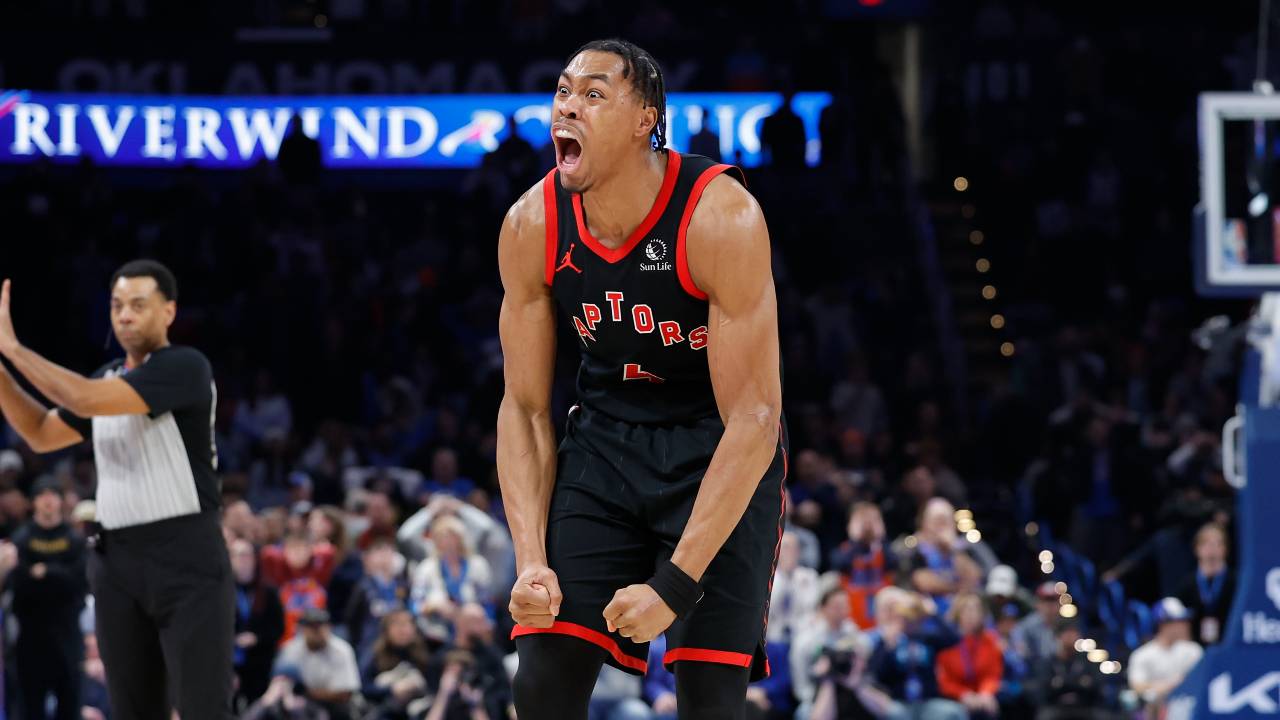
And there we have it. Scottie Barnes is officially an All-Star for the second time in his career. It’s a well-deserved honour for the fifth-year forward (wing, centre, guard, etc) that has led the upstart Toronto Raptors from the Eastern Conference’s basement to a top-four seed with the trade deadline and All-Star break coming up over the next couple weeks.
Barnes has taken an atypical path to the 2026 All-Star Game, achieving recognition with team-first play that starts on the defence. He’s done almost everything, aside from dribbling and shooting his way to gaudy scoring totals like many of his peers.
Consider many of his All-Star contemporaries: Jaylen Brown, Cade Cunningham, Luka Doncic, Jalen Brunson, Tyrese Maxey, Kevin Durant, Anthony Edwards, Donovan Mitchell, Devin Booker. They all score over 25 points per game. They all average at least seven pull-up jumpers – some of them much more. Barnes is averaging 3.1 pull-ups per game and averaging 19.4 points.
Non-observers of the Raptors this season from outside markets could be baffled at the hype Barnes is receiving, considering his box-score stats are largely unchanged year-over-year.
Here are Barnes’ per-game averages over the last three seasons, including the current one. He was an All-Star in 2023-34, wasn’t in 2024-25, and is again now:
2023-24: 19.9 points, 8.2 rebounds, 6.1 assists, 2.8 stocks
2024-25: 19.3 points, 7.7 rebounds, 5.8 assists, 2.4 stocks
2025-26: 19.4 points, 8.3 rebounds, 5.6 assists, 2.8 stocks
But anyone who consistently watches the games knows that this season has been different.
He’s a monster on the defensive end. Stalking around off the ball like the predator, ready to devour his prey (the ball). His mere presence as the next defender in the gaps or as the low man is often enough to dissuade drives, and when it isn’t, even Joel Embiid and Chet Holmgren can get some. Barnes’ ground coverage is outrageous. He uses his outlier mix of length, athleticism, activity and feel to shrink the floor on defence and the results are truly terrifying for opponents.
His name is being called more frequently and louder in Defensive Player of the Year conversations, and his case is becoming difficult to ignore. We might have all heard the numbers before, but they bear repeating. Barnes leads the league with 136 stocks (steals+blocks).
More, he leads the league with eight clutch blocks, helping contribute to the Raptors’ No. 1 clutch defence (97.1 points per 100 possessions) He’s top ten in total deflections and fourth in distance travelled on defence. Which makes sense because he’s everywhere. Think the killer’s gone? Nope, actually right behind you and he’s got the ball.
One of the greatest testaments to Barnes’ defensive talent is how the Raptors’ defence has survived without a true centre. Alongside rookie Collin-Murray Boyles, Barnes has been the primary reason why. Opponents shoot 5.7 percent worse at the rim with Barnes on the floor versus when he’s off, a 93rd percentile mark among big men, according to Cleaning the Glass, which now categorizes Barnes as a big based on how often he’s been the nominal five. He’s contested the sixth-most shots within six feet of the basket this season, just behind Rudy Gobert and Myles Turner and ahead of Holmgren, the DPOY frontrunner.
It’s also notable how the Raptors’ rebounding has held up when Barnes plays without Poeltl – they’ve maintained average rates on the boards when centreless. His uber athleticism combined with his gargantuan reach allows him to go up and high-point rebounds over big men, rendering even seven-footers too small at times.
Not only is Barnes able to step up and fulfill the role of a centre to a well above-average standard, but he can also do everything else too. From guarding the best opposing wing scorer to even handling guards at the point of attack, he’s among a select few defenders that can truly guard one-through-five competently. Es Baraheni included in his piece making a case for Scottie as Defenisve Player of the Year that he ranks in the 87th percentile in B-Ball Index’s “Defensive Positional Versatility” tool, “which measures how many positions a player defends and how often.” That matches the eye test.
He also guards plenty of stars and has often taken on the assignment of denying them the ball when the Raptors decide to enact that strategy. We saw it most recently in the win of the season against Shai Gilgeous-Alexander and the Oklahoma City Thunder. It’s not often you see All-Stars playing deny defence, but Barnes is the exception.
Barnes does it all. He plays every position. Sometimes he brings the ball up, sometimes he’s setting (slipping) screens and catching on the roll. Sometimes he’s lurking the dunker or spotting up. He picks up opposing guards at the point of attack. He roams off his man in the gaps or sweeps the backline from the weak side. He has spent plenty of time as the nominal centre during Jakob Poeltl’s extended absence. We see point-Scottie rear his head at times. His primary role is either a big wing or point-forward type. He truly does it all.
Again, except for scoring off the bounce and with the pull-up jumper the way a typical star does.
But while he leads with defence, Barnes is still a multiskilled offensive weapon. He’s a bruiser at his position and can swiftly put mismatches in the rim. He’s among the league’s most efficient high-volume transition players. Catching with momentum towards the rim is easy money.
And aside from transition, which has remained steady – mostly because he’s asked to rebound so often and hurl hit-ahead passes, which he’s also great at, as we saw on this hail mary to Ja’Kobe Walter – he’s using all these play types more this season. His roll-man volume is up, his cutting volume is up, and he’s scoring more efficiently as a result.
After refining his mid-range game last season, it hasn’t gone away, but has instead been used as a counter when the defence gives it to him. Barnes has comported himself to his role brilliantly.
His true shooting was 52.3 percent last season (abhorrent) and is 57.6 percent now (roughly league average). His field goal percentage is up from 44.6 to 50.1, 3-point percentage from 27.1 to 30.5 as he takes less pull-ups and more shots in rhythm.
That goes without mentioning Barnes’ most elite offensive talent by far, his passing. Be it pin-point hit-ahead passes like the one linked above that travel most of the length of the court, his signature no-look live-dribble defence-manipulating feeds or a seemingly innate ability to read defences from the middle of the floor, Barnes is among the best in league. Don’t let the assist numbers fool you. He had five more assists in the Raptors’ last game against the Magic and was looking at his target on one of them.
That’s how Barnes stepped up and took a spot on the All-Star team once again. By playing winning basketball. Except this time, his team is actually winning the games. He’s a defender first, unusual when it comes to All-Stars. Few others in his cohort are. He doesn’t break down his check and make spectacular shots. Instead, he’s workmanlike. Pounding the rock inside, threading skillful passes, exerting himself with leap after leap until he’s grabbed a franchise-record-tying 25 rebounds, led the Raptors to victory, and collapsed on the bench. An All-Star of the people. And Barnes deserves to be celebrated as such.