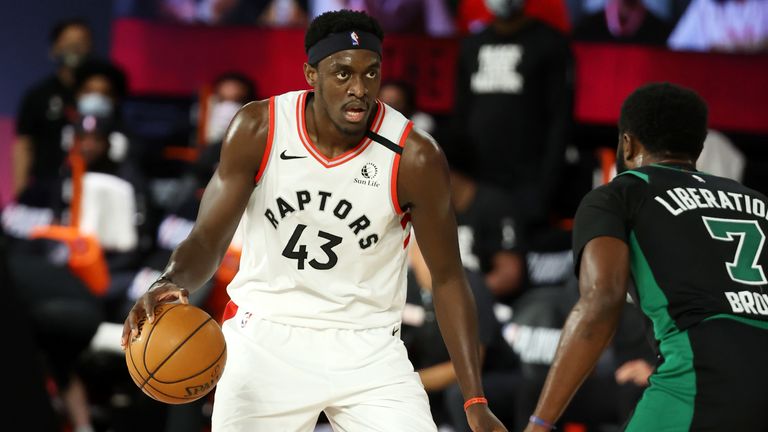
Pascal Siakam is not going to magically become a superstar overnight.
When Masai Ujiri, Nick Nurse & co. set out to have Siakam learn to be The Guy, they were well aware that it wasn’t going to happen over the course of one regular season. Arguably, Game 2 against the Boston Celtics presented the first real high leverage learning moments as the No. 1 option.
Stepping out of bounds — barely — on the biggest possession of the game was painful, no doubt. Zooming in on the series and what’s needed to beat the Celtics, of course Siakam hasn’t done enough and there’s a decent amount he could do better. But this was always going to be part of the learning curve and perhaps we need to zoom out for just a minute.
Siakam has been playing the game of basketball for seven years. He was drafted 27th overall in 2016 and was compared to Bo Outlaw by then head coach Dwane Casey. Take a second and think about that: A rim-running energy big who never averaged more than 9.5 points per game in the NBA. He struggled so much in his rookie season that he was sent down to the G League. From there, he went on one of the most remarkable stretches of improvement to emerge as the second-best scorer and the third-best player on a championship team while winning the NBA’s Most Improved Player award in the span of two seasons. Quite the return on investment for a player who earned a total of approximately $4 million over the first three years of his career.
With Toronto acquiring Kawhi Leonard in the final year of his contract, the departure of both left an especially giant vacuum. The Raptors had no cap flexibility and were stuck with no choice but to depend on who they had to fill in and do as best a job they could. Siakam was slotted into the premier role in the final year of his rookie contract — earning $2.35 million, and was tasked with learning life as The Guy. Emphasis on LEARNING. And that’s right, Siakam hasn’t even begun to earn his max rookie-scale contract extension yet.
Rome wasn’t built in a day, Nick Nurse didn’t become a championship level head coach overnight, and the team that won the Larry O’Brien trophy most certainly wasn’t built in one off-season. And if learning during a normal year was going to be challenging enough, Siakam was also forced to reckon with having no access to a basketball court for the longest time since he began playing the game itself due to the COVID-19 global pandemic.
With all that in mind now, let’s zoom back in again and identify what Siakam can take from this game to be better going forward.
FACE UP/DRIVE GAME
For the post-season, Siakam is producing 1.08 points per post-up possession, a notable improvement from the 0.92 points per in the regular season. For reference, no one posted up more than Joel Embiid in the regular season and his 1.1 points per post up led the league in efficiency. Nikola Jokic leads the playoffs with an insane 1.37 points per post-up. Siakam’s frequency has increased from 12.2 percent to 19.5 percent, and this can be attributed to the increased frequency with which the Raptors have had to rely on their half-court offence.
All that being said, I still believe that variability and attacking defenders with a head of steam allows for better scoring opportunities for not only Siakam but the Raptors, and there certainly was a healthier mix of it in Game 2 as opposed to Game 1. He was consistently able to get a step on Jaylen Brown and get to the basket, though his shot selection was still a little hurried at times. Be quick, but don’t rush.
DECISION MAKING
Siakam made good decisions overall and the ones that weren’t should be fixable by watching some film. He created open shots for his teammates consistently and in a game decided by three points, it’s hard not to look back and think about how differently he’d be viewed if teammates had stuck some of their open looks. He had six assists to just a single, heartbreaking turnover.
Where the Cameroonian did have trouble sometimes was recognizing when he had a matchup advantage/disadvantage. Siakam occasionally killed his dribble or passed off in the face of Kemba Walker before forcing the defence to collapse (Play 6 – 0:53, Play 8 – 1:18, Play 12 – 1:56), or looked to attack Marcus Smart when that’s virtually the equivalent of posting up Kyle Lowry. Every single opportunity he has to attack Walker should be a barbecue chicken alert with extra spicy jalapenos on the side. And that doesn’t necessarily have to be to score, when he forced a double or created space for a teammate, that’s job done, too. That’s part of being The Guy, being absolutely ruthless in punishing any weakness on the defence’s part. Part of that is coaching, too, and ensuring your players are put in the best position to succeed and ensuring they recognize where their best opportunities lie.
If there was anything that was really frustrating, it was a possession (Play 4 – 0:34) where he matched up with Jayson Tatum and really seemed to get sucked into getting the better of him and forced up a couple ugly shots. There was really only a couple of times where he didn’t recognize the opportunity for a kick-out after drawing a double (Play 7 – 1:09, and that’s going to happen in his first year as the main man.
DEFENCE
Siakam’s awareness and intensity is still a work in progress. There are times where he drifts based on the situation of the game, and there were occasions where he wasn’t as locked in as you’d like him to be. Another possible weakness in his defensive approach that Robert Williams seemed to take full advantage of his Siakam’s propensity to close out to the perimeter. There’s good and bad to everything, and while Siakam is fantastic at contesting three-point shots, there are occasions where he’s got to be more cognizant of the threat at the rim. Plays 3 and 4 (0:18) below, show Siakam first not tagging or impeding Williams’ progress to the rim in any way when Gasol is helping on Walker, and immediately after, Siakam is initially on the interior for Brown’s drive but rushes out to the perimeter in anticipation of a pass out to Ojeleye when the more imminent threat is clearly Williams underneath the rim.
The two plays after that (0:32) you see exactly the benefits of his ability to recover in a split second and close out on shooters.
The final play is a really bad one from Siakam, selling out to Tatum’s fake and giving up a wide-open three-pointer that looked like it knocked the wind out of the Raptors’ sails at the time.
DEFENDING SCREENING ACTION
Another aspect I wanted to highlight was how the Celtics used screens to create space for their ball handlers — especially in the latter stages of the game — going up against Siakam. The Raptors’ bigs didn’t drop as deep as they did in Game 1, but it’s still making life very difficult for the primary defenders, especially when Theis is proving to be an absolute behemoth setting screens, leaving Walker and Tatum with a significant advantage against Toronto’s centres.
One thing Siakam could do better is immediately cut off the weakside drive and tail the ball-handler from behind to direct them and deter the possibility of a shot attempt with his length as opposed to trying to fight directly through.
CRUNCH TIME
Siakam’s possible evolution into becoming The Guy for real is going to be contingent on executing in the big moments. Stepping on the line was extremely unfortunate, but it’s important to remember that part of why the Raptors created that final opportunity because of the way he stepped up.
First, when they were on the ropes around the four-minute mark and trailed by eight, he drove to the rim and got to the line to stop the bleeding. Immediately after, he picked Smart’s pocket off a high screen that led to his own post-up on Walker, patiently waited for the double, then kicked out for a VanVleet 3-pointer that cut the lead to three.
One thing, as mentioned earlier, that needs to be a no-brainer lesson from this game is that Siakam does not have an isolation advantage against Smart. At the very minimum, there needs to be some sort of screening action involved.
I’m sure Nurse would have loved to have Gasol out on the court for those final possessions to give Boston a taste of their own medicine with his screens, and hopefully there’s more of that in store for Game 3.
***
Just as Siakam’s struggles as a rookie and his time in the G League helped him develop into an NBA level contributor, and just as missing 25 three-point attempts in a row with the Bench Mob was part of the process in him becoming a respectable outside shooter, these lessons are going to help Siakam become a better player moving forward.
Whether that player is actually an A1 level superstar is unknown, but Siakam has shown enough with the opportunity he has been given to learn this year, that there is still enough in his game that can be levelled up and improve the Raptors’ ceiling.